Insight
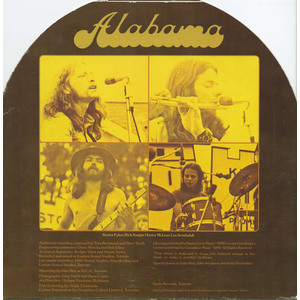
Alabama were a Toronto-based band formed around 1972 by James “Buster” Fykes, Hector McLean, Rick Knight and Len Sembaluk. Led by the songwriting partnership of Fykes and Knight, the group drew from progressive rock, Cajun rhythm, country, folk-rock and Southern soul, creating a sound that sat outside the polished Nashville mainstream. Fykes and Knight were both originally from Alabama, and after settling in Ontario they brought those southern influences into a Canadian setting, shaping a roots-based style with the loose, road-worn feel of the early-seventies bar-band circuit.
The group released two singles on Toronto’s Smile Records, distributed by London Records. “Song of Love” reached the Canadian RPM Top 100, peaking at No. 26 in June 1973, while the follow-up, “Highway Driving,” climbed to No. 42 later that summer. “Highway Driving” became the band’s best-known song, a free-wheeling road tune built around long-distance travel, small-town gigs and the familiar pull of the Trans-Canada Highway. With its opening line, “Ninety miles to North Bay, and I’m on the road again,” the song captured the grind and romance of Canadian touring life in a way that stayed with listeners long after the band’s brief run had ended.
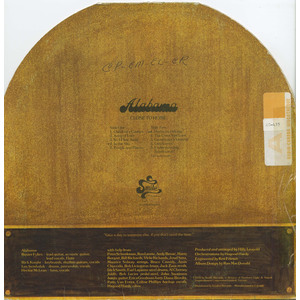
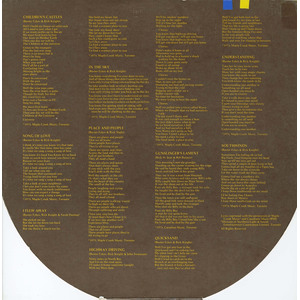
Alabama’s lone LP, Close to Home, was released by Smile Records in late 1973. Recorded at Eastern Sound Studios in Toronto with producer and arranger Hilly Leopold and engineer Ken Friesen, the album gave the band a fuller studio setting than the basic four-piece lineup suggests. The sessions included a wide group of Toronto players, with John Swainson on banjo and guitar, Al Cherny on fiddle, Bob Lucier on pedal steel guitar, Erica Goodman on harp, Hagood Hardy on vibraphone and orchestrations, plus brass, reeds, strings, steel drums and backing vocals. The result was a warm and unusually layered country-rock record, moving from the reflective “Children’s Castles” and “People and Places” to the road-song momentum of “Highway Driving” and the western sweep of “Gunslinger’s Lament.”
In 1974, Alabama received Juno Award nominations for Best Country Group or Duo and for Best Single, Country, with “Highway Driving.” Those nominations placed them among the Canadian acts helping to broaden country-rock beyond traditional country forms, bringing in rock, soul, Cajun flavour and a distinctly Canadian sense of distance and place.
The group dissolved soon after its short recording run, leaving behind two singles and one album. After Alabama, Buster Fykes remained active as a performer in Central Ontario, while Rick Knight and Len Sembaluk moved further into studio work, including engineering credits on recordings by The Stampeders and other Canadian artists. Sembaluk had earlier played drums with Toronto rock band Brutus, another connection tying Alabama into the wider Toronto music scene of the late 1960s and early 1970s.
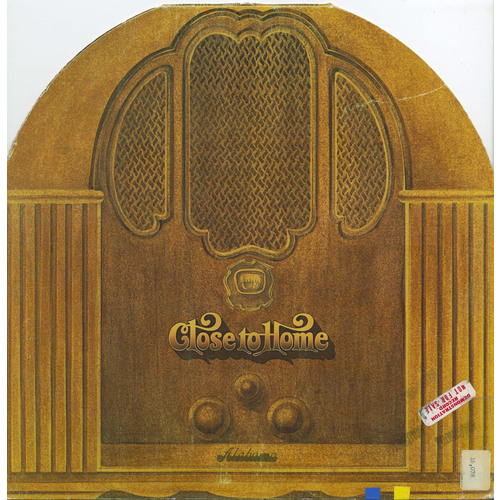
Close to Home remains a memorable document of early-seventies Canadian roots-rock: melodic, carefully played, and grounded in the sound of musicians who understood both southern songcraft and Canadian road life. Original Smile Records pressings have become collectible, helped by the album’s distinctive die-cut radio-style sleeve and by the lasting appeal of “Highway Driving,” one of the great overlooked Canadian road songs of its era.
-Robert Williston
Gallery
Images
6 images
Alabama - Close to Home BACK
Alabama - Close to Home INSIDE 01
Alabama - Close to Home INSIDE 02
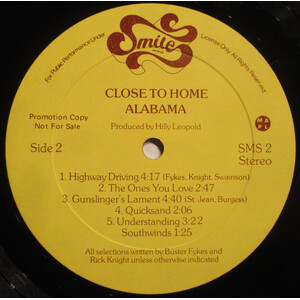
Alabama - Close to Home
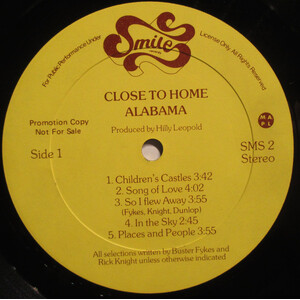
Alabama - Close to Home
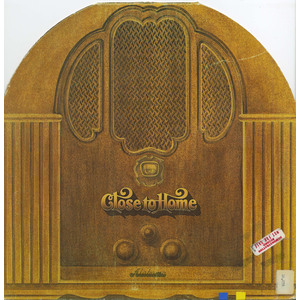
Close to Home
Media
Videos
0 videos
No videos available for this title.
Credits
Musicians
Buster Fykes: lead vocals, lead guitar, acoustic guitar, flute
Rick Knight: keyboards, rhythm guitar, vocals
Hector McLean: bass, vocals
Len Sembaluk: drums, percussion, vocals
John Swainson: banjo, guitar
Al Cherny: fiddle
Bob Lucier: pedal steel guitar
Erica Goodman: harp
Hagood Hardy: vibraphone, orchestrations
Arnie Chycoski: brass
Bob Livingston: brass
Bruce Cassidy: brass
Jack Zaza: reeds
Strings
Andy Benac
Arnie Chycoski
Bill Richards
Harry Bregart
Josef Sera
Maurice Solway
Peter Schenkman
Ron Laurie
Vicki Richards
Dick Smith: steel drums
Earl LaPierre: steel drums
Colina Phillips: backing vocals
Diane Brooks: backing vocals
Patty Van Evera: backing vocals
Production
Produced and arranged by Hilly Leopold
Engineered by Ken Friesen
Recorded at Eastern Sound Studios, Toronto, Ontario
No Comments