Insight
Colin Adjun was one of the North’s most beloved traditional fiddlers, an Inuit musician from Kugluktuk, Nunavut (formerly Coppermine, Northwest Territories) whose spirited playing earned him the enduring nickname “Fiddler of the Arctic.” For decades, Adjun’s reels, jigs, waltzes, and old-time dance tunes were a fixture at community dances, festivals, house parties, and concerts across the western Arctic, where his music became deeply woven into the social life of the North. In Kugluktuk especially, his influence was profound: generations grew up jigging to his fiddle, and after his death in 2021, family and community members spoke of him not simply as a performer but as a cultural force whose music had helped define the town itself. In December 2022, the hamlet formally renamed its community hall Colin Adjun Hall in his honour, a lasting tribute to the joy and pride he brought to the community through a lifetime of music.
Born in January 1944 in the Read Island area, northeast of Kugluktuk, Adjun was raised on the land during a period when Inuit families in the region still lived seasonally and permanent settlements were not yet the norm. The back-cover notes to his 1981 LP Fiddler Of The Arctic describe him as having been born “somewhere in the Coppermine region of the NWT in a summer camp,” reflecting the same broader geography and era. According to later family and community accounts, he first received a fiddle at age nine from a man sailing past the family’s camp. From there, he began learning tunes from his uncles, Charlie Avakana and John Kuneyuk, while living at an outpost camp. Like many great northern fiddlers, Adjun learned entirely by ear, without formal music reading, developing an instinctive style rooted in listening, memory, and the social function of the music itself. His daughter Barb later recalled that he could hear a tune once and immediately play it back, a gift that stayed with him throughout his life.
Like many great community musicians, Adjun’s art grew out of function rather than commercial ambition. His fiddle was meant for dancing—for square dances, weekend gatherings, old-time socials, community halls, and living rooms where people wanted to jig or waltz. The back-cover notes to Fiddler Of The Arctic describe a musician who had already spent years playing at “festivals, old time dances, concerts and house parties,” while also working for the Renewable Resources Department out of Coppermine, where his responsibilities included wildlife surveys and polar bear denning studies. Later family memories paint much the same picture: if someone called asking him to play, he would go, even if it meant leaving supper unfinished. As his daughter Barb recalled after his death, he felt a strong responsibility to the people who came to hear him, telling her simply, “I’ve got to play for these people. They made me who I am.” That sense of duty to community would remain central to his reputation for the rest of his life.
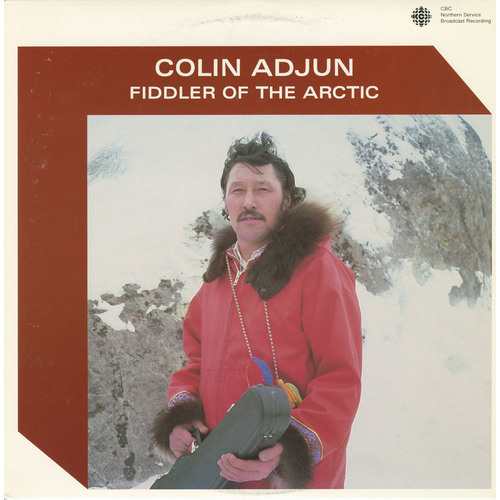
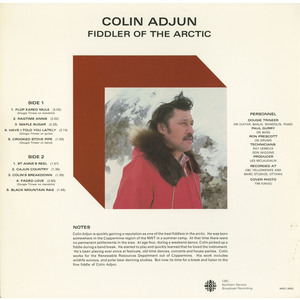
Adjun’s first widely documented recording, Fiddler Of The Arctic, was issued in 1981 by CBC Northern Service Broadcast Recording (WRC1-3452). The album remains one of the key commercially released documents of Inuit fiddling from the western Arctic, capturing Adjun in a straightforward and highly effective dance-band setting. Backed by Dougie Trineer (guitar, banjo, mandolin, piano), Paul Gurry (bass), and Ron Prescott (drums), the LP was produced by Les McLaughlin and recorded at CBC Yellowknife and Marc Studios, Ottawa. Its repertoire—drawing on pieces such as “Flop Eared Mule,” “Ragtime Annie,” “Maple Sugar,” “St Anne’s Reel,” “Crooked Stove Pipe,” “Faded Love,” and “Black Mountain Rag”—shows how naturally Adjun moved between standard North American fiddle repertoire and the distinctive northern dance context in which he performed. The album’s own liner notes described him as “quickly gaining a reputation as one of the best fiddlers in the arctic,” a statement that would prove increasingly true in the decades that followed.
He later recorded two more albums, Dusty The Leader and Beluga Waters, both of which helped define the mature phase of his career. Dusty The Leader was issued on World Record Corp WRC8-7612, while Beluga Waters became especially significant in northern music history as the first all-original fiddle album from what is now the Northwest Territories and Nunavut. That distinction, later emphasized by the Canadian Grand Masters Fiddling Association in announcing Adjun’s 2024 induction into the Canadian Fiddle Hall of Honour, confirmed what northern audiences had long understood: Adjun was not only a gifted interpreter of traditional repertoire, but also a composer whose music reflected the land, wildlife, and lived experience of the western Arctic. Surviving documentation from the Beluga Waters era shows evocative titles such as “Gustin’s Reel,” “Beluga Waters,” “The Politicians Jig,” “Northern Lights Waltz,” “Memories of Mom,” “Flight of the Gyrfalcon,” “Back to the Fishing Camp,” “After the Storm,” “Cod Liver Medicine,” and “The Arctic Terns,” underscoring how closely his writing was tied to family life, community memory, and the northern environment.
By the 1990s and 2000s, Adjun had become a regular and much-loved figure on the northern festival circuit. He performed at Yellowknife’s Folk on the Rocks, Iqaluit’s Alianait Arts Festival, Inuvik’s Great Northern Arts Festival, and the Adäka Cultural Festival in Whitehorse, and in 2013 he also appeared at the National Arts Centre’s Northern Scene Fiddle Showcase in Ottawa. Earlier profiles also note performances in places such as Anchorage, Whitehorse, Inuvik, and Cape Breton, underscoring how far his reputation had spread. Yet for all his travels, his music remained inseparable from the social purpose it served at home: getting people up to dance. In Kugluktuk, his style was so central to community life that, as his daughter put it after his passing, “everyone in town knows how to jig” because of him.
Music was inseparable from family life in the Adjun household. His children grew up in a home where music was always present, from country and old-time tunes to records by Elvis Presley and even opera. After dinner, family members might jig or waltz while he played. That tradition extended directly into the next generation: his youngest son Gustin Adjun also took up the fiddle at a young age, and later performed publicly with his father, helping carry forward the Kugluktuk fiddle tradition. Photographs from Adjun’s later years show him on stage with Gustin and younger family members, reflecting a legacy that was as much familial and communal as individual.
Adjun’s contributions were recognized formally as well as affectionately. He received the Queen Elizabeth II Golden Jubilee Medal in 2002, the Queen Elizabeth II Diamond Jubilee Medal in 2012, and in 2009 served as the Olympic Torchbearer through Kugluktuk on dog sled. In 2024, he was posthumously inducted into the Canadian Fiddle Hall of Honour by the Canadian Grand Masters Fiddling Association, a fitting national recognition for a musician whose influence had long been obvious across the North but was only gradually being acknowledged more broadly in Canadian fiddle history.
Colin Adjun died in Ottawa on December 3, 2021, at the age of 77. The news was met with an outpouring of grief and gratitude across Nunavut and the wider North, with family members describing a man who felt a profound responsibility to the people who danced to his music. His daughter Barb remembered that if someone called asking him to play, he would go without hesitation, because he believed those people were the reason he mattered. That memory says almost everything about his place in northern music history. He was not a celebrity in the southern industry sense, but something rarer and more enduring: a community musician of extraordinary skill whose fiddle helped define the emotional and social life of a place.
-Robert Williston
Musicians
Colin Adjun: fiddle
Dougie Trineer: guitar, banjo, mandolin, piano
Paul Gurry: bass
Ron Prescott: drums
Production
Produced by Les McLaughlin
Recorded at CBC Yellowknife and Marc Studios, Ottawa
Technicians: Ray Lemieux, Don Wiggins
Artwork
Cover photography by Tim Knivig
Liner notes
Colin Adjun is quickly gaining a reputation as one of the best fiddlers in the arctic. He was born somewhere in the Coppermine region of the NWT in a summer camp. At that time there were no permanent settlements in the area. At age four, during a weekend dance, Colin picked up a fiddle during a band break. He started to play and quickly learned that he loved the instrument. He’s been playing ever since at festivals, old time dances, concerts and house parties. Colin works for the Renewable Resources Department out of Coppermine. His work includes wildlife surveys, and polar bear denning studies. But now its time for a break and listen to the fine fiddle of Colin Adjun.
Gallery
Images
2 images
Colin Adjun - Fiddler Of The Arctic BACK
Fiddler Of The Arctic
Media
Videos
0 videos
No videos available for this title.
Credits
In Transit
No Comments