Artist / Band
Steve Karliski
Biography
Steve J. Karliski (March 10, 1940 – October 2007) was a Canadian songwriter and singer whose career bridged the Tin Pan Alley–style publishing world of 1960s New York and the Nashville country market, while also producing a small but distinctive body of recordings under his own name. Known primarily for his songwriting successes, Karliski was also a performing artist whose recordings reveal a more personal, reflective side of his work.
Born in Winnipeg to Ukrainian immigrant parents, Karliski began writing both lyrics and melodies in his teens. Drawn to the professional songwriting world, he relocated to New York in the early 1960s, where he quickly became part of a circle of working writers and publishers. During this period, he worked alongside figures such as Carole King, Neil Sedaka, Barry Mann, and Larry Kolber, placing material with major artists and developing a reputation as a writer with a strong melodic sense and emotionally direct storytelling.
Karliski’s most widely known success came with ‘Yes, Mr. Peters,’ co-written with Larry Kolber and recorded by Roy Drusky and Priscilla Mitchell. The song reached number one on the U.S. country charts in 1965 and became a defining entry in his catalogue. His work was subsequently recorded by a number of leading country artists of the era, including Bill Anderson and Jan Howard, Waylon Jennings, and Faron Young, placing Karliski among a small group of Canadian-born writers whose songs became part of the core Nashville repertoire.
Other notable placements included ‘For Loving You,’ recorded by Bill Anderson and Jan Howard; ‘Christina,’ recorded by Waylon Jennings; ‘Yellow Bandana,’ recorded by Faron Young; and ‘Then Came the Bad Years,’ also recorded by Bill Anderson. His song ‘Molly’ became another signature title, widely recorded and later frequently cited by Karliski himself as one of his most meaningful works. Together, these recordings established Karliski primarily as a behind-the-scenes hit songwriter, even as his own recordings remained comparatively rare.
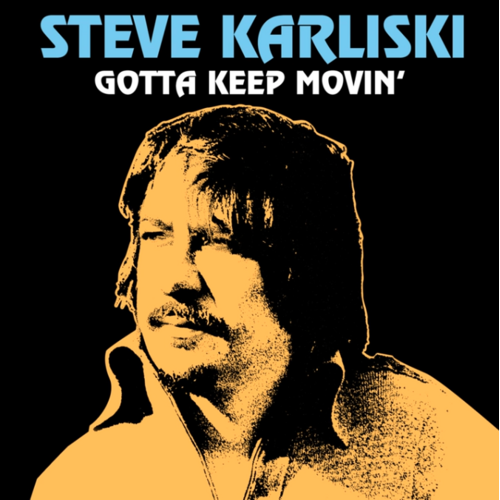
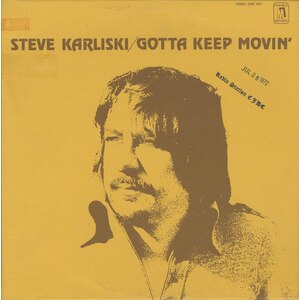
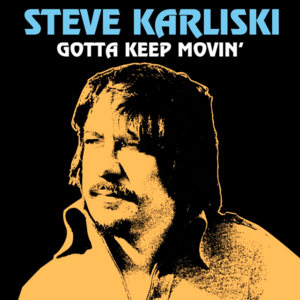
Although best known for his songwriting, Karliski also recorded as a solo artist. His album Gotta Keep Movin’, issued on Ralph Murphy’s Double M label, features Karliski performing his own compositions, including several titles already familiar through hit recordings by Roy Drusky and Priscilla Mitchell, Bill Anderson and Jan Howard, Waylon Jennings, and Faron Young. The album presents a more intimate view of his writing, allowing listeners to hear his songs as he originally conceived them, rather than solely through the interpretations of Nashville performers.
The album also reflects themes that recur throughout Karliski’s catalogue: sensitivity balanced with realism, emotional directness, and a focus on life’s quieter turning points rather than overt spectacle. The liner notes emphasize his preference for letting the songs speak for themselves, describing him as an “ultimate realist” who believed the music carried more truth than biography.
In his later years, Karliski returned to Canada and settled in Niagara Falls, Ontario, where he continued writing actively until his death in 2007. Local arts sources and colleagues recall him as a prolific craftsman whose output extended far beyond his best-known titles, with numerous unpublished or lesser-known works circulating privately. Even in this later period, songwriting remained central to his life, reflecting a career defined less by celebrity than by long-term dedication to the craft.
-Robert Williston
Tracks
10 tracks
Gotta Keep Movin' (1972)
10 tracks
-
Gotta Keep Movin'
-
Takes a Woman Like You
-
Ask Me Anything
-
Home Comes the Hero
-
And Then Came the Bad Years
-
Molly
-
For Loving You
-
Not the Way That They Used to
-
At Least One Time
-
Think of the Good Times
Discography
Featured Titles
Albums
Gallery
Images
1 image
Karliski, Steve
Media
Videos
0 videos
No videos available for this artist.