Artist / Band
Guilt Parade
Biography
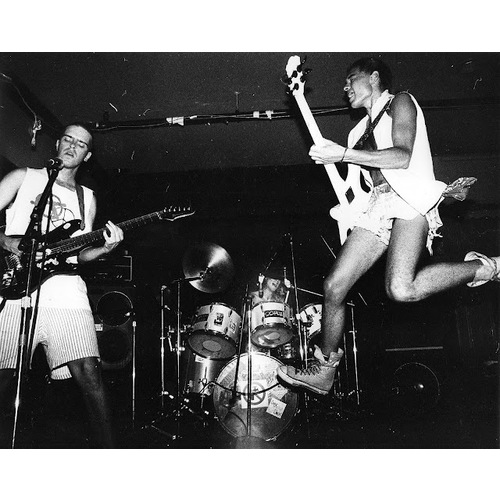
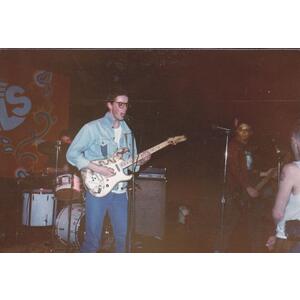
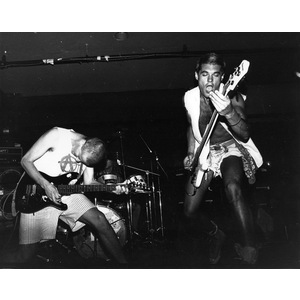
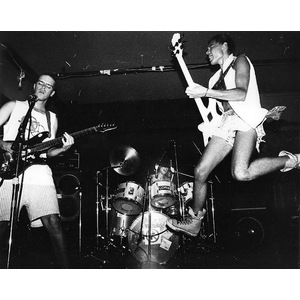
Guilt Parade were a hardcore punk band formed in Fredericton, New Brunswick, around 1985 by guitarist and vocalist Jeff Beardall, bassist and vocalist Richard Bird and drummer Todd Merrill. Fredericton had a substantial artistic community but little established punk infrastructure at the time, with much of the city’s live circuit devoted to cover bands. Beardall and Bird found an important outlet through the University of New Brunswick radio station, where they hosted a program called Journey Through a Body, named after the Throbbing Gristle album.
Beardall and Bird had previously played punk covers together and briefly attempted an original group called The Beach Psychos. When that band’s rhythm section showed little interest in the faster and more confrontational music they wanted to pursue, the pair started again with Merrill, who had previously played guitar in the St. Stephen post-punk group The Lads. They took the name Guilt Parade from a song by The Birthday Party, one of several groups that shaped their interest in music that was abrasive, challenging and difficult to categorize.
Their early influences included Minor Threat, 7 Seconds, B.G.K. and the Dead Kennedys. Beardall later recalled that hearing the Dead Kennedys, particularly the material surrounding Plastic Surgery Disasters, changed his musical direction. Its combination of darkness, political intelligence, speed and humour helped define the kind of hardcore Guilt Parade wanted to create. Once Beardall and Bird began writing original songs, the material developed quickly, and within a few months the trio had enough music to record its first cassette.
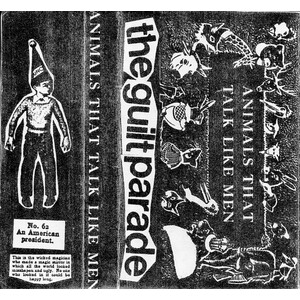
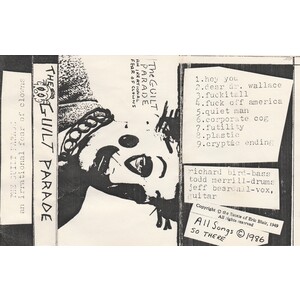
Guilt Parade issued two self-released demo cassettes, An Irrational Fear of Clowns and Animals That Talk Like Men, during its original Fredericton period. The first tape received an encouraging review from Tim Yohannan in the April 1986 issue of Maximum Rocknroll, which praised the band’s playing, lyrics and energetic hardcore sound while noting that its Washington, D.C. influence did not make the music generic.
Animals That Talk Like Men followed later in 1986. Its ten songs included ‘Take No Risks’, ‘Let’s Be Honest’, ‘The Jesus Janitor’, ‘Religion in American Life’, ‘Ode to an Asshole’, ‘Surfin’ Nuclear’, ‘Zinja Zobulawa’, ‘The Todd Incident’, ‘Oppenheimer’s Legacy’ and a live version of ‘Dear Dr. Wallace’. The insert credited all lyrics and music to Guilt Parade except ‘Surfin’ Nuclear’, written by Chris Saad in 1985.
Walter Glaser reviewed the cassette in the August 1986 issue of Maximum Rocknroll, describing the band’s music as innovative hardcore and thrash distinguished by humour, experimentation and strong production. He concluded that the material deserved to be released as a record. The response gave Beardall greater confidence that Guilt Parade could find an audience beyond Fredericton.
The group began performing outside New Brunswick while still operating with the original Beardall–Bird–Merrill lineup. Guilt Parade played with The Nils in Fredericton and later shared a Halifax bill with the Nils and the Jellyfishbabies. Beardall later recalled that Chris Murphy of Sloan told him that seeing this Halifax performance helped convince him that he could start a band. The story remains Beardall’s recollection rather than an independently documented statement from Murphy.
Touring from Fredericton was difficult. The musicians had little money, limited experience and an unreliable van, and the original lineup completed only a small number of Maritime trips. Even so, the performances helped connect Guilt Parade with a wider network of musicians, promoters and listeners at a time when the Atlantic Canadian punk scene was still developing.
An important early opportunity came through Deja Voodoo. After seeing Guilt Parade open a University of New Brunswick show, Gerard Van Herk encouraged the band to perform in larger centres and submit a song to the It Came from Canada compilation series. ‘Ode to an Asshole’ appeared on It Came from Canada Volume 2 in 1986, followed by ‘The Todd Incident’ on Volume 3 in 1987.
‘Ode to an Asshole’ was written as a humorous caricature of the aggressive small-town figures encountered by punks and other outsiders in New Brunswick. Beardall remembered it as an accessible song that opened doors for the band and helped establish its reputation outside Fredericton.
Guilt Parade also contributed a version of ‘Heartbreak Hotel’ to the Canadian benefit compilation Still Thinking Presents: Progress?!. A contemporary Maximum Rocknroll review singled out the Guilt Parade track as one of the record’s standouts.
The band’s move to Toronto began after Bird decided to attend York University. Beardall followed, frustrated by Fredericton’s insular and conservative atmosphere, and Merrill also initially made the move. The original lineup soon came apart, however. Merrill was more interested in pursuing a Joy Division-influenced direction and was replaced for a period by Mike, a drummer from one of his earlier bands. When that arrangement ended, Beardall and Bird briefly considered using a drum machine.
They eventually recruited Chris ‘Flea’ Lee, who had played with Toronto punk group Groupoem. Lee’s speed and technical ability allowed Guilt Parade to pursue a tighter and more complex form of hardcore. Bird later relocated to Montreal, beginning a succession of changes in the bass position. Brad Crewson, Steve, Jim Field and Brent Ruddy each played with the band at different stages, while Dallas Good briefly joined as a second guitarist near the end of its existence.
Guilt Parade’s connection with Fringe Product developed after Brian Taylor of Youth Youth Youth heard one of the band’s demos. Taylor worked at Toronto’s Record Peddler, which was associated with Fringe, and enthusiastically brought the tape to the label. Fringe subsequently signed Guilt Parade and agreed to press and distribute an album. Although the label provided little direct touring support, its position within Canadian punk distribution gave the group greater access to venues, promoters and listeners across the country.
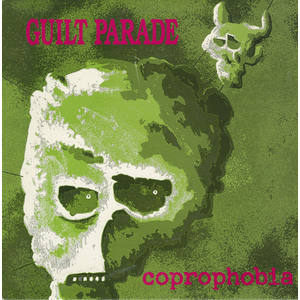
The resulting album, Coprophobia, was recorded at Umbrella Sound between October 1988 and March 1989 and released by Fringe Product in 1989. It contained sixteen short songs combining fast political hardcore, technical playing, absurdist humour and an increasingly heavy musical attack.
The album featured Beardall on vocals and guitar and Lee on drums and percussion, with bass credited to Richard Bird and Brad Crewson. James Stanley and Rick Winkle recorded the sessions, and production was credited to Guilt Parade and Stanley. Beardall later recalled that another bassist, Steve, appeared on one album track, although the surviving sleeve credits do not identify which recording featured him.
Several songs from the Fredericton tapes were revisited for the album, including ‘Surfin’ Nuclear’, ‘The Jesus Janitor’, ‘Religion in American Life’ and ‘Ode to an Asshole’. Newer material included ‘Monochrome’, ‘Head Enema’, ‘Corporate Cog’, ‘Yen for Zen’, ‘Powered by Sugar’, ‘World Gone Mad’, ‘Frustrated Americans’, ‘Tar Pits’ and ‘I Win’.
Following the album’s release, the Beardall–Lee–Crewson lineup toured across Canada, travelling first to Fredericton and later west to British Columbia. The band performed in centres including Sault Ste. Marie, Winnipeg, Calgary and Kelowna and generally received a strong response. The tour was entirely do-it-yourself: the musicians repaired and modified their van, constructed their own equipment storage and learned how to keep the vehicle running while crossing the country.
Guilt Parade later toured through the United States with MDC and Forced Anger. Beardall remembered occasional confrontations with far-right nationalists during the American dates, but the band completed the tour without any serious physical altercations. Jim Field subsequently became one of Guilt Parade’s more enduring bassists and toured extensively with the group across North America.
The band recorded demos intended for a second album, but the project was never released. Some of the new material was, in Beardall’s estimation, among the band’s better later work, but Fringe showed little interest in issuing it. Continuing personnel changes, the loss of one former bassist, the difficulty of finding a stable musical collaborator and the constant effort required to maintain an independent touring band gradually exhausted the remaining members.
By the beginning of the 1990s, the underground landscape was also changing as groups such as Sonic Youth and Soundgarden pointed toward different approaches to heavy independent music. Lee left Toronto, and Beardall no longer felt able to supply the energy required to keep Guilt Parade moving forward. The band dissolved, and Beardall later formed The Satanatras with Dallas Good.
Although Guilt Parade left behind only two demo cassettes, one album and a handful of compilation appearances, its influence extended well beyond that small catalogue. Propagandhi have identified the band as one of their most important formative influences, describing Coprophobia as a bridge between the punk groups they admired and the metal bands they loved. They later acknowledged that their earliest recordings were, in essence, attempts to sound like Guilt Parade.
Propagandhi again placed Guilt Parade alongside Voivod, Rush, SNFU, Sacrifice and Razor among the Canadian groups whose work informed the 2009 album Supporting Caste.
-Robert Williston
Tracks
0 tracks
No tracks available for this artist.
Discography
Featured Titles
Albums
Compilation Tracks

Gallery
Images
3 images
Guilt Parade
Guilt Parade
Guilt Parade
Media
Videos
0 videos
No videos available for this artist.