Artist / Band
Anthony Green & Barry Stagg
Biography
In April 1970, RPM reported that a Montreal single was shaping up as a strong contender for length of stay on the RPM 100. It came from two young Montrealers singing in English on a French-Canadian label. Anthony Green & Barry Stagg, issued by Gamma as GS 504, was Gamma’s first English-language release, and Gamma’s president, Daniel Lazare, produced it himself.
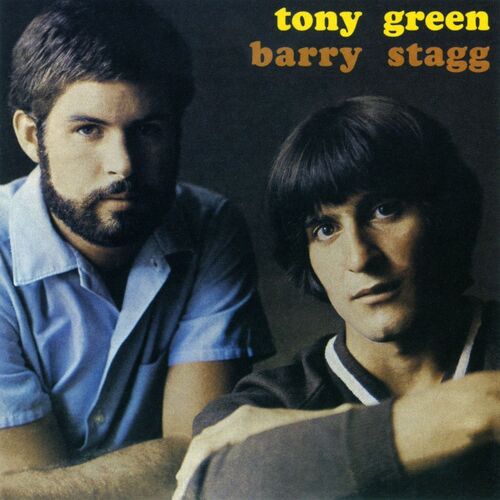
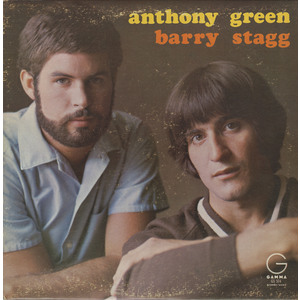
Barry Stagg met songwriter Anthony “Tony” Green after university, and Green pushed him to record. The pair cut a simple two-track demo with Ben Kaye, who took it to Lazare. All eleven songs on the album are Green and Stagg compositions, published through their own Greenstagg Publishing Co., and they include ‘Linda’, which Stagg wrote when he was eleven. Leon Aronson arranged and conducted, Paul-Emile Mongeau engineered, and Ronald Labelle shot the photographs and designed the jacket. The two voices sit in close harmony over light folk-pop arrangements dressed with strings and baroque touches. ‘Face of the Sun’ breaks open with bursts of fuzz guitar, and ‘Cathy’ is over in under two minutes. On the back cover, under the borrowed line “We hold these truths to be self-evident,” the two writers signed a creed of their own: “that life is love, that to love means to be free.”
‘To Love Means to Be Free’ opened the album and went out as Gamma single 5001 early in 1970. It reached No. 42 on the RPM 100 and No. 3 on RPM’s Canadian content chart, and appeared on the magazine’s list of recommended middle-of-the-road Canadian titles. Lazare licensed it widely: United Artists released it in the United States, Barclay in France, and EMI in Australia and New Zealand. The LP climbed to No. 75 on RPM’s album chart, and United Artists issued it in the U.S. as UAS 6756. The duo also guested on the first taping of CTV’s Nashville North, alongside Anne Murray, Bobby Bare and Sylvia Tyson.
BMI Canada named ‘To Love Means to Be Free’ among its 1969 Certificate of Honour songs, and Lazare accepted the award from BMI’s Harold Moon in June 1970. Gamma followed with ‘Face of the Sun’ (Gamma 5004), which stood at No. 16 on RPM’s Canadian chart in early October. Green and Stagg later moved to London Records and kept releasing singles into 1973. Unidisc eventually collected the album, those later singles and Italian-language versions of ‘To Love Means to Be Free’ and ‘Peaches Candy’ on a CD titled Tony Green & Barry Stagg.
Stagg settled in Nova Scotia in the 1970s and made solo records for RCA, including a self-titled 1978 album cut in Halifax. He then turned to the stage, writing musicals and operas for the NOSCO Academy of Theatre Arts, and he still writes and performs from Spruce Pine, North Carolina.
After the duo ended, Green, born Antonio Mazzone, moved into dance music. He became one of Montreal’s busiest disco producers and ran his own Tony Green Organization and its TGO label. In 1978 he wrote ‘Come to Me’ for France Joli, a teenager from Dorion, Quebec, and produced her debut album. Prelude released it in 1979, and ‘Come to Me’ reached No. 15 on the Billboard Hot 100 and spent three weeks at No. 1 on Billboard’s dance chart.
-Robert Williston
Tracks
11 tracks
-
To Love Means to be Free
-
Fantasy With You
-
Turn Away
-
Laughing Girl
-
Life and Love
-
Face of the Sun
-
Linda
-
Cathy
-
Beside You Again
-
If Ever
Discography
Featured Titles
Albums
Gallery
Images
1 image
Green, Anthony & Barry Stagg
Media
Videos
0 videos
No videos available for this artist.