Artist / Band
Everyday People
Biography
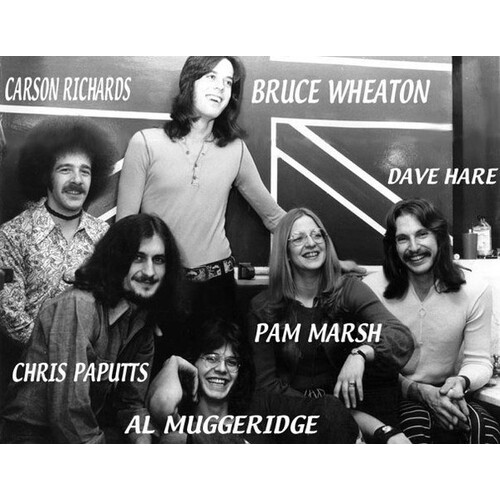
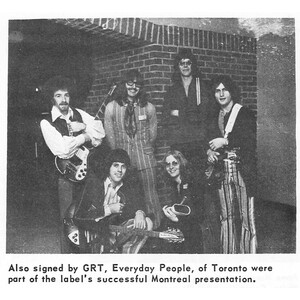
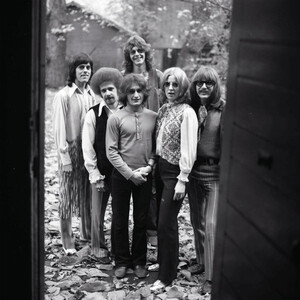
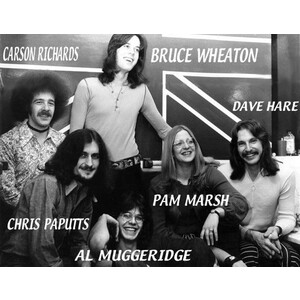
Everyday People were a Toronto six-piece whose sound moved between rock, soul and funk, built around the guitarist, singer and songwriter Bruce Wheaton. A native of Amherst, Nova Scotia, Wheaton had already been through The Stitch In Tyme before assembling the group in Toronto with Pam Marsh on vocals and keyboards, Carson Richards on bass, Al Muggeridge on drums, Dave Hare on keyboards and Chris Paputts on guitar and harp. Marsh and Richards were both from Halifax. Muggeridge came from Barrie after almost two years with Cathedral. Hare was from Oshawa and had earlier managed Jack London & The Sparrows. Paputts, born in Florina, Greece, had spent four years with New Breed. Marsh had worked the Nova Scotia circuit with Myles Goodwyn in East Gate Sanctuary before Goodwyn left for Montreal and April Wine and she headed for Toronto.
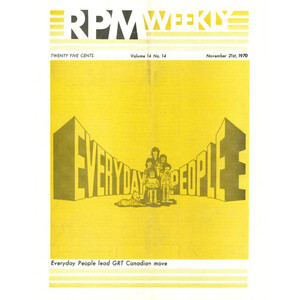
The break came through Terry Brown and Doug Riley and their Dr. Music operation at Toronto Sound Studios. In November 1970 GRT of Canada announced a long-term production agreement with Brown and Riley covering Everyday People, Terry Bush and Beverly Glenn-Copeland, part of the label’s sudden push into Canadian recording. GRT had spent most of its existence distributing outside labels. Now, with Canadian-content regulations about to reshape radio, it was building a domestic roster of its own, and Everyday People were among the first acts through the door.
Their debut, ‘You Make Me Wonder’ / ‘Nova Scotia Home Blues’, GRT 1233-01, appeared late in 1970. Both songs came from within the band: Wheaton wrote ‘You Make Me Wonder’, while he and Marsh wrote ‘Nova Scotia Home Blues’. Terry Brown produced the session at Toronto Sound for Dr. Music, and GRT made a point of the record’s Canadian credentials, putting an oversized MAPL symbol on the release. On November 16 the band played GRT’s Montreal launch party in front of more than 200 press, radio and television guests, sharing the bill with Ronnie Hawkins and Cane and Abel. RPM came away praising the group’s harmonies, instrumentation and live presence, and ‘You Make Me Wonder’ was already getting airplay across the country.
The record turned into a two-sided success. Cash Box reported that ‘Nova Scotia Home Blues’ was starting to pull attention away from the designated A-side, and by December 26 it had reached No. 20 on RPM’s MOR playlist. ‘You Make Me Wonder’ made the national RPM 100 and reached No. 60 before dropping back in January 1971. That was a substantial first result for a new band on a label only beginning to build a Canadian catalogue.
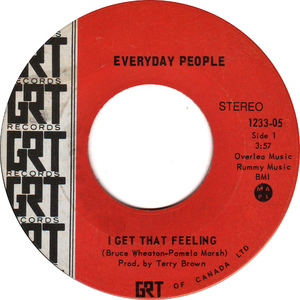
The second single, ‘I Get That Feeling’ / ‘Experience In Love’, GRT 1233-05, followed in 1971 with Terry Brown producing the A-side. It put Pam Marsh out front. She co-wrote ‘I Get That Feeling’ with Wheaton, sang the lead and played the organ, with Doug Riley sitting in on piano. GRT worked the record well beyond Toronto. In June, Wheaton joined label and Dr. Music representatives on a Saskatchewan promotion run through Saskatoon, Moose Jaw and Regina, and by August RPM was reporting that a successful western tour of promotion and personal appearances had given the single new life. At the same time Dr. Music closed negotiations with Paramount Records for an American release of the album, with a U.S. single to follow.
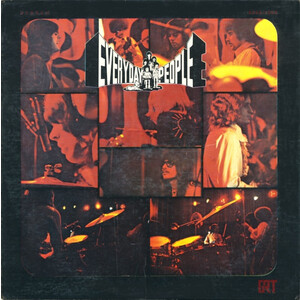
The self-titled Everyday People, GRT 9233-1002, appeared in 1971. Nine of its ten tracks carry Wheaton’s name, with Marsh sharing ‘I Get That Feeling’ and ‘Nova Scotia Home Blues’, and the tenth is Sly Stone’s ‘Everyday People’. The arrangements spread the work around. Wheaton and Paputts supplied the guitars, Marsh and Hare moved between piano, organ and electric piano, Richards and Muggeridge held the rhythm section, and Wheaton, Marsh and Paputts all took lead or harmony vocals. Doug Riley added piano to ‘I Get That Feeling’, Marsh reached for a bullbell on ‘Travellin’’, and the whole band is credited with the percussion on ‘I Like What I Like’. Paul Weldon designed the logo and Ken Mulveny shot the cover.
The album stayed close to the Toronto Sound and Dr. Music circle. Everyday People themselves took a production credit, with Terry Brown producing seven tracks and Steve Kennedy three, and Peter Houston engineering with Dave Slagter and Paul Reagin assisting. A U.S. release through Paramount followed from the Dr. Music deal. GRT was still putting serious effort behind the record in early 1972. On January 26 the company held a launch party during a two-week Everyday People engagement at Toronto’s Gasworks, where RPM reported lineups stretching around the block, and when RPM reviewed the LP in February it singled out the production and the material and pointed programmers toward ‘Don’t Wait For Tomorrow’.
The band then did what a developing Canadian act had to do, which was work. Roscoe Productions booked a February 1972 swing through the Atlantic provinces that RPM described as the most extensive eastern-seaboard tour yet undertaken by a recording group. The schedule crossed New Brunswick, Nova Scotia and Prince Edward Island repeatedly, with stops in Fredericton, Saint John, Bathurst, Dartmouth, Moncton, Charlottetown, Halifax, Amherst, Yarmouth, Sydney and Summerside. For Wheaton, Marsh and Richards it was a return to the part of the country much of the group had come from.
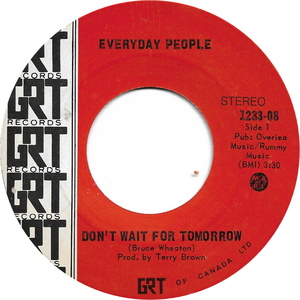
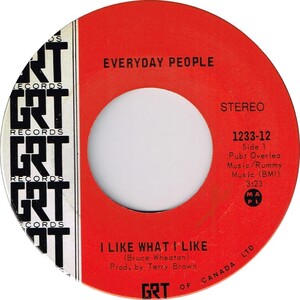
GRT kept pulling singles off the album. ‘Don’t Wait For Tomorrow’ and the Sly Stone cover ‘Everyday People’ appeared together as 1233-08, and in March 1972 the six-minute ‘I Like What I Like’ came out as 1233-12, backed with ‘Don’t Wait For Tomorrow’ and again produced by Brown. In the United States, Paramount issued ‘Experience In Love’ backed with ‘I Like What I Like’ as PAA-0157 in April 1972, and later gave ‘I Like What I Like’ its own release as PAA-0226, split across both sides of the 45.
‘I Like What I Like’ had a much longer life than its release schedule suggests. Written by Wheaton and built on Pam Marsh’s lead vocal, it found a following in dance clubs and was picked up by other singers. Cass Elliot recorded it for her 1973 live album Don’t Call Me Mama Anymore, where Wheaton is credited as the writer.
The band’s biggest national pop record came from outside the album. ‘Feelin’ Better Already’, written by Wheaton and produced by Brown at Toronto Sound, appeared as GRT 1233-14 in the summer of 1972. It won the Maple Leaf System vote in August and climbed to No. 37 on the RPM 100 on September 9, and GRT marked the MLS win with another celebration at the Gasworks. The single was moving while the band was in the middle of a two-month tour that took in the Toronto Fair, McMaster University, Oshawa and a long run of Toronto-area clubs, straight after another Maritime swing through Halifax, Dartmouth and Moncton.
There was one more chart record. Early in 1973 GRT issued ‘To-Day I Feel Like Being Happy’ / ‘Music Man’ as 1233-16. The new side started showing up in station reports from Calgary, Thompson and Fort McMurray in February and March, entered the RPM 100 and worked its way to No. 77 by April 28. It crossed over more strongly to adult-contemporary radio, reaching No. 31 on RPM’s Adult Contemporary Playlist on June 16.
RPM’s June 1974 Who’s Who still listed Everyday People as a GRT recording group, managed by Rummy Music and booked by Music Shoppe International, with ‘Today I Feel Like Being Happy’ as their latest single, out on a national tour and with television appearances on Rolling On The River and Musical Friends behind them. Wheaton’s own account puts the final tour later in 1974. When it ended he went back to the East Coast and formed Molly Oliver that fall.
The members scattered into very different corners of Canadian music. Wheaton and Richards carried on together in Molly Oliver, a partnership that ran through to 1980. Marsh became an in-demand singer, working with Sylvia Tyson and Crowbar and adding session vocals to records by April Wine, Michel Pagliaro and Rick James. Paputts made the sharpest turn of all. Later in the decade he became Chris Hate, the original bassist of Toronto punk pioneers The Viletones.
They did come back together. On October 4, 2003, Wheaton, Marsh, Richards, Hare, Muggeridge and Paputts reunited at the Halifax Forum for the Classic Rock Concert, and the following day Everyday People and Molly Oliver were recognized during Nova Scotia Music Week for their contribution to the province’s musical legacy. Wheaton had the surviving studio material remastered in 2004, adding five recordings that never made the original album.
Everyday People left one album and a short run of singles, and that modest discography hides a band that worked nationally for the better part of four years. They were among GRT’s first serious Canadian signings, carried an emphatic MAPL stamp just as the content rules came into force, crossed the country on promotion and performance tours, reached the RPM charts repeatedly and found a U.S. outlet through Paramount. One of Wheaton’s album songs went further than the record it came from. ‘I Like What I Like’ made it out of the Toronto clubs and onto a Cass Elliot album inside of two years.
-Robert Williston
Lineup:
Bruce Wheaton: lead and rhythm guitar, lead and harmony vocals
Chris Paputts: rhythm, lead and twelve-string guitar, harp, lead and harmony vocals
Pam Marsh: piano, organ, electric piano, lead and harmony vocals, bullbell
Dave Hare: piano, organ, electric piano
Carson Richards: bass
Al Muggeridge: drums
Doug Riley: piano on ‘I Get That Feeling’
Tracks
4 tracks
Everyday People (1971)
4 tracks
-
I Get That Feeling
-
Experience in Love
-
I Like What I Like
-
Don't Wait for Tomorrow
Discography
Featured Titles
Albums
Singles
Gallery
Images
4 images
RPM promo
Everyday People
Everyday People
Everyday People
Media
Videos
1 video