Artist / Band
Doug Nepinak
Biography
Douglas Raymond Nepinak, a Saulteaux writer and playwright, was born on June 19, 1960, to Jonas and Marie Therese Nepinak of Pine Creek First Nation, on the southwestern shore of Lake Winnipegosis between Camperville and Duck Bay. He was educated in residential school.
In 1979, Nepinak joined the Canadian Armed Forces and served in the navy until 1986. A former shipmate later recalled sailing with him for four years aboard HMCS Restigouche.
In 1987, he entered what he called the “white man’s” education system. He completed a Bachelor of Arts Honours degree in English at the University of Winnipeg in 1993, though he liked to say that he had learned most from the school of hard knocks.
His writing was appearing in print before he graduated. Border Crossings published “Two Poems by Douglas Raymond Nepinak” in its December 1992 First Nations Art & Culture issue. His work later appeared in Crossroads, Prairie Fire and Contemporary Verse 2, as well as in the book A History of Manitoba and educational material prepared for the Ontario Ministry of Education.
Nepinak worked as an editor with Weetamah, Manitoba’s Aboriginal newspaper, and later became Communications Advisor to the Assembly of Manitoba Chiefs. He stated his purpose plainly:
“I’m an Indian Propagandist. That’s what I am. I write for Indian people.”
Nepinak and his wife, actor Tracey Nepinak, founded the Indigenous theatre collective As the Bannock Burns. The company was active in Manitoba by 1998, and Tracey later recalled it as the place where she began developing her work as a director.
Nepinak’s The Crisis in Oka, Manitoba was presented at Native Earth Performing Arts’ Weesageechak Begins to Dance Festival XII in November 1999, directed by Alanis King. As the Bannock Burns mounted the play at the Winnipeg Fringe Festival in 2000, followed by a Red Roots Theatre production in Winnipeg in 2001.
The Crisis in Oka, Manitoba is set during the 1990 Oka Crisis, although Nepinak wrote it nearly a decade later. Its characters are members of an Indigenous family in Winnipeg’s North End. Isaiah, one of the younger family members, wants to go to Oka in support of the Mohawk resistance. As he tells his family, “being born an Indian in Canada is a political act.”
In 2001, As the Bannock Burns presented BBQ at Prairie Theatre Exchange. Nepinak was nominated the following year for the John Hirsch Award for Most Promising Manitoba Writer. He also wrote six radio dramas for CBC Radio.
In March 1999, Nepinak was among the founders of Winnipeg’s Aboriginal Writers Collective. Other members included Marvin Francis, Rosanna Deerchild, Trevor Greyeyes, David McLeod, Jordan Wheeler and Duncan Mercredi. Its first chapbook, Urban Kool, appeared in 2000 and included Nepinak’s work. The collective later published a second chapbook, Bone Memory, and the spoken-word CD Red City. One of Nepinak’s own poems was also titled ‘Bone Memory’.
The Autumn 2001 issue of Prairie Fire, First Voices, First Words, was devoted to First Peoples writing and guest-edited by Thomas King. Nepinak advised the project, and the issue published his poems ‘Ghost Dance’ and ‘The Myths My People Told’. The latter begins:
“The myths my people told are very far from me.”
Doug Nepinak died of cancer on August 13, 2005, at the age of 45. His wife Tracey and his mother Marie Therese were with him. His father Jonas had died before him. A wake was held at the Old School Gym in Pine Creek on August 17, followed the next day by his funeral at Our Lady of Seven Sorrows Stone Church in Camperville.
Exactly six weeks after his funeral, on September 29, 2005, Theatre Projects Manitoba opened Nepinak’s Coo-Coosh. Directed by Ross McMillan, the production featured Herbie Barnes as Derek, Columpa C. Bobb as Maddy and Cliff Cardinal as Clarence, and ran through October 9.
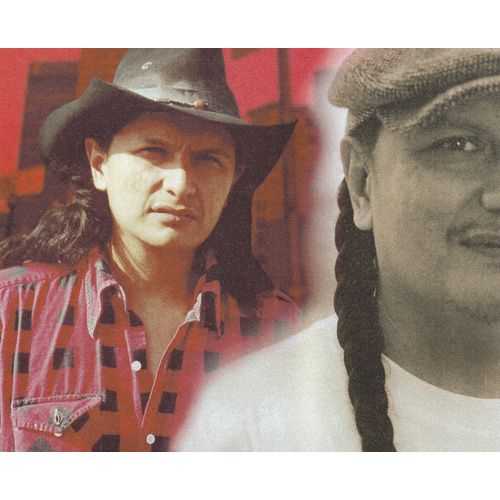
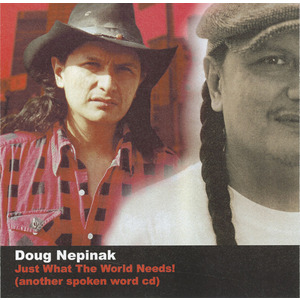
Later in 2005, Lost Dog Records issued Just What The World Needs!, with “(another spoken word cd)” printed as the subtitle on the cover. The 31 selections brought together Nepinak’s poetry, prose, live performances, conversations and interviews. Among them were ‘My Father’, ‘The Myths My People Told’, ‘Ghost Dance’, ‘Clarity’, ‘Healing Song’, ‘My Two Grandfathers’, ‘Forgetting’, ‘Crazy Horse’, ‘Bone Memory’, ‘Main Street’ and ‘Free’.
Jesse Green supplied music for ‘Forgetting’ and ‘Crazy Horse’, Billy Joe Green played guitar on ‘Clarity’, and Ray “Co-Co” Stevenson contributed traditional music to ‘Ghost Dance’. James Creasey handled production and sound design, Keni (Clark) Harvey shared production duties, and David McLeod coordinated the project. The package was assembled as a memorial to Nepinak, carrying his dates, family photographs and recollections from people who had worked with him.
The Winter 2006 issue of Contemporary Verse 2 published an interview with Nepinak. In 2010, The Crisis in Oka, Manitoba appeared in This Is an Honour Song: Twenty Years Since the Blockades. That September, CBC Radio and Native Communications Inc. recorded a new radio adaptation before live audiences in Winnipeg. Tracy McCorrister directed, Ross McMillan adapted the script, and Dave Boulanger and the Winnipeg band Burnt supplied the original music.
In 2012, Manitowapow: Aboriginal Writings from the Land of Water included three of Nepinak’s works, ‘Main Street’, ‘Bone Memory’ and ‘indians’, identifying him as Douglas Nepinak, Saulteaux, 1960–2005.
His obituary, published in the Winnipeg Free Press on August 16, 2005, opened with his own words:
“Everything that I am fits in a teardrop that evaporates.”
-Robert Williston
Tracks
31 tracks
What the World Needs! (2005)
Showing 10 of 31 tracks
-
Origins
-
Crows
-
My Father
-
Earth
-
The Myths My People Told
-
My Grandmother's Mother
-
This Trip
-
Ghost Dance
-
Clarity
-
Flesh (Live)
Discography
Featured Titles
Albums
Gallery
Images
1 image
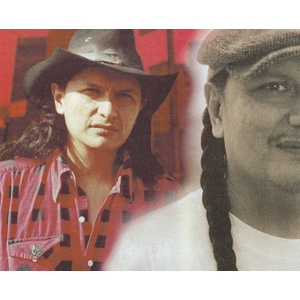
Doug Nepinak
Media
Videos
0 videos
No videos available for this artist.