Artist / Band
Flokons Givrés
Biography
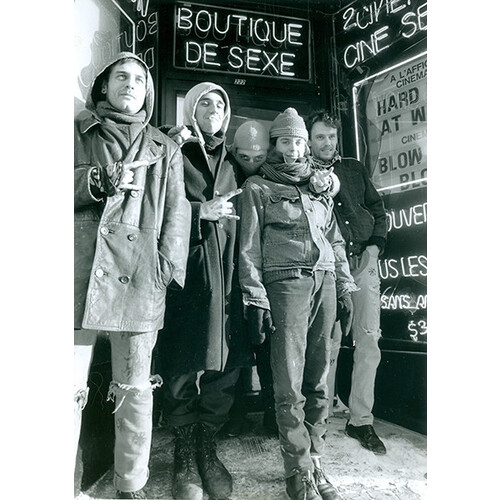
Among the many groups that crawled out of Montreal's late-'80s punk underground, Flokons Givrés left behind an unusually large reputation for a band with such a small recorded catalogue. Built around Guy Landry and Bertrand Boisvert, with drummer Peter Boucher, known as Banchon, the trio operated somewhere between punk, hardcore and metal, delivering short, primitive songs in an unmistakably Québécois vernacular. Landry handled guitar and shared vocals with bassist Boisvert, while Boucher supplied the drums. Their drinking songs, profanity and deliberately dishevelled image could make Flokons Givrés appear almost frivolous at first encounter, but beneath the self-destructive humour lay a band with considerably more to say.
The group's beginnings date to the end of the 1980s. Later accounts identify 1989 as the period in which their first demo began circulating, initially in small quantities before being duplicated and recopied throughout the underground. The material spread by word of mouth across Quebec and eventually much farther afield, while the band remained principally active during the years around 1989 to 1992. The cassette Born To Be Vedg..., documented in its surviving form as a 1990 release, represents an early version of the repertoire that would become synonymous with the group. Its songs already contained most of the Flokons vocabulary: intoxication, unemployment, squatting, frustration, social alienation, contempt for authority and the peculiarly Québécois art of doing absolutely nothing with conviction.
The title itself captured much of the attitude. To vedger in Quebec slang is essentially to vegetate, loaf around or waste time, and Vedg à l'os transformed that state into something approaching a philosophy. Its protagonist wanders Sainte-Catherine, finds a squat, begs for change and contemplates his increasingly wrecked existence while repeatedly declaring himself vedg à l'os. The language was never polished into standard French, and that was precisely its strength: Landry and Boisvert wrote and sang in the clipped, phonetic street French they actually spoke. The same approach runs through Pu rien à boire, whose narrator wakes up wrecked before launching into a rejection of work, bosses, promotions and respectable adulthood. Rather than disguising their surroundings, Flokons Givrés made Montreal itself part of the vocabulary of the songs.
Nowhere was that more obvious than Barré des Foufs, their French-language adaptation of Banned from the Pubs by Peter and the Test Tube Babies. The Foufs were the Foufounes Électriques, the Sainte-Catherine Street club that had become one of Montreal punk's principal institutions. In the Flokons version, getting barred from the place after drinking, vomiting and confronting the doorman becomes both a joke and a miniature piece of scene autobiography. The song eventually became one of the numbers most closely associated with the group. It also illustrates an important part of their appeal: these songs did not describe punk culture from a safe distance. They sounded as though they had been written in the middle of it.
That reputation for disorder followed them onto the stage. Later recollections portray Flokons Givrés concerts as unpredictable affairs, with unreliable equipment, arguments, extended guitar playing and Banchon sometimes reaching the limits of his patience. Yet when the three musicians locked together, the effect could be ferocious. Surviving concert documentation places the group alongside bands including B.A.R.F. and Glorious Fail during the early 1990s, firmly locating them within Montreal's harder underground. Their mixture of hardcore speed, metallic guitar and ragged punk looseness distinguished them from more conventional francophone punk and gave the recordings a character that survived their deliberately crude production.
The apparent stupidity of some of the songs also concealed a surprisingly sharp political streak. L'escargot moves through war, dictatorship, military repression, Indigenous land conflict, imprisonment and social abandonment before retreating into the image of the snail as someone refusing participation in the surrounding machinery. An alternate version of the lyric replaces a general reference to territorial rights with a direct mention of Robert Bourassa, revealing how closely at least one version was tied to contemporary Quebec politics. La mentalité, meanwhile, adopts the voice of a racist skinhead only to expose him as violent, conformist and intellectually vacant; by its conclusion the song explicitly turns against the people it has been mocking. Kriss d'osti d'tabarnak similarly fires in several directions at once, touching on social assistance, taxation, pollution of the St. Lawrence, the destruction of belugas, racism, nationalism, war and the pursuit of money. These were not political songs in any disciplined ideological sense, but the nihilism was accompanied by a clear awareness of racism, militarism, environmental destruction and institutional stupidity.
The homemade cassette eventually travelled much farther than its circumstances suggested it should. By the early 1990s, Born To Be Vedg had entered the wider underground tape-trading and mail-order network, where its fast, rough-edged French-language hardcore found listeners well beyond Montreal. Its reputation continued to grow even as the group's principal period of activity was winding down. Flokons Givrés did not completely disappear after 1992 either; surviving documentation indicates sporadic later performances, making those first few years better understood as their most concentrated period rather than an absolute beginning and end.
The environment surrounding the band was as important as any formal career trajectory. Flokons Givrés belonged to a downtown Montreal punk culture built around clubs, rehearsal rooms, squats, cheap recordings and duplicated cassettes rather than conventional record-company infrastructure. Places such as the Foufounes Électriques were not simply venues but part of the band's subject matter, while other underground spaces provided stages for groups that existed largely outside the commercial music industry. That intimacy between everyday life and songwriting gave the Flokons material much of its lasting identity: Sainte-Catherine Street, getting thrown out of clubs, unemployment, welfare, drinking, wandering and political frustration were all allowed to exist in the songs exactly as they did in the band's world.
By the end of the 1990s, recordings that had begun life as cassette-culture ephemera were already acquiring a second life. The material was reissued on compact disc in 1999 by L'Empire Kerozen, ensuring that songs previously passed from hand to hand on tapes remained available after the original format had begun disappearing. The recordings themselves were documented as having been made at Lunatic Asylum, giving a name at last to the place where much of the familiar Flokons repertoire had been captured.
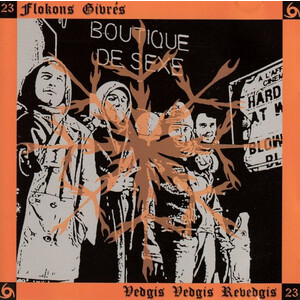
A more substantial archival treatment followed in 2011, when Just Fucking Music issued the remastered vinyl LP Vedgis Vedgis Revedgis. Limited to 1,000 copies, including 500 on clear vinyl, the album collected twelve pieces from the band's cassette-era repertoire and was mixed and mastered by Thierry Gauthier, with technical work by Bowell. The LP gathered familiar material including Mescaline, Hymne au Seigneur, Pu rien à boire, Barré des Foufs, Mon linge est sale, L'escargot, Vedg à l'os, La mentalité and La bébitte, while also including Vide and an alternate Pu rien à boire (Version $150). The final song on each side continued into a run-out loop, an appropriately unruly detail for recordings that had never been particularly interested in behaving themselves.
The 2011 liner notes demonstrated that the band's personality had survived the process of archival preservation intact. Rather than offering conventional thanks, the Flokons announced that they remained firmly committed to thanking nobody, while nevertheless saluting Luce Ribourtou, Gabrielle Lussier, Karine Brisebois and Peter Boucher, described collectively as fallen comrades. Henriette Valium received an honorary mention as an inexhaustible source of ambiguity, while Fred Box was acknowledged for his ambulatory chaos. Beneath the joke was also the reality that the original group was gradually disappearing. Peter Boucher died in 2005 and was remembered in Montreal music circles for his work with both Flokons Givrés and Fail Safe. Bertrand Boisvert died in 2015, and Guy Landry, the last surviving member of the original trio, died in early 2025.
By then another generation had already demonstrated that the songs had not been forgotten. In 2024, the tribute Vedgis Revedgis Flokonum revisited virtually the entire core Flokons repertoire through performances by younger Quebec underground groups. Mescaline, Hymne au Seigneur, Pu rien à boire, Barré des Foufs, Kriss d'osti d'tabarnak, L'escargot, Vedg à l'os, La mentalité and La bibitte had survived more than three decades beyond the cheaply duplicated cassette on which many listeners first encountered them. What had begun as an intensely local collection of songs about drinking, squatting, frustration and life in Montreal had become part of the inherited vocabulary of Quebec punk.
That endurance is ultimately what separates Flokons Givrés from countless other basement punk groups of the period. They never built anything resembling a conventional career, and by all surviving accounts were hardly interested in doing so. Their recordings were primitive, their performances could collapse into disorder and several of their best-known songs celebrated being drunk, broke, barred from clubs or simply too vedg to participate in respectable society. Yet those same recordings contained flashes of political anger, social observation and an unusually distinctive use of Québécois language. A cassette passed from hand to hand became an underground cult recording, resurfaced on compact disc and vinyl, and eventually inspired an entire tribute album. For a band that seemed determined not to take itself too seriously, Flokons Givrés proved remarkably difficult to forget.
-Robert Williston
Musicians
Guy Landry: vocals, guitar
Bertrand Boisvert: vocals, bass
Banchon (Peter Boucher): drums
Tracks
11 tracks
Vedgis Vedgis Revedgis (1990)
Showing 10 of 11 tracks
-
Mescaline
-
Pu rien à boire
-
Barré des Foufs
-
Kriss d'osti d'tabarnak
-
Mon linge est sale
-
L'escargot
-
Vedg à l'os
-
La mentalité stimportant
-
La bibitte
-
Hymne au Seigneur
Discography
Featured Titles
Albums
Gallery
Images
1 image
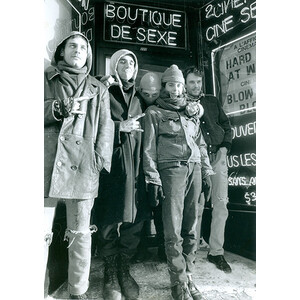
Flokons Givrés
Media
Videos
1 video