Artist / Band
Eric Travers (aka Eric Kagna)

Biography
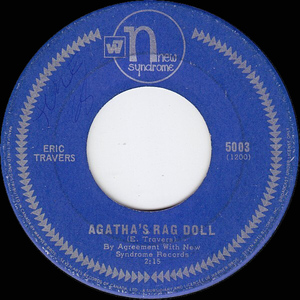
Eric Travers was the recording name used by Eric Kagna, a Vancouver-connected Canadian songwriter, musician, lawyer, and behind-the-scenes figure whose short recording career later became tied to a much larger story in Canadian pop music. In June 1968, he released the single “Agatha’s Rag Doll” b/w “Alie Do This” on New Syndrome Records. Written by Travers himself, the record sits in the late-1960s borderland between folk rock, psychedelic pop, and singer-songwriter experimentation, with “Agatha’s Rag Doll” capturing the period’s fascination with strange characters, nursery-rhyme imagery, and offbeat melodic turns.
After his brief appearance as a recording artist, Kagna remained connected to music in a different way. He became involved in Vancouver’s music community as a lawyer, adviser, and supporter of local musicians, and was an early friend and legal representative for Bryan Adams. As Eric Kagna, he contributed to several early Adams-related songs, including “Hidin’ From Love,” “Straight From The Heart,” “Can’t Wait All Night,” and “Win Some Lose Some.” Those songs connected him not only to Adams and Jim Vallance, but also to a wider Vancouver circle that included Prism, Bruce Fairbairn, and Paul Dean.
Kagna’s songwriting credits travelled well beyond Canada. “Straight From The Heart” became one of Bryan Adams’ breakthrough ballads and was also recorded by Bonnie Tyler, Rosetta Stone, Anne Murray, and others. “Hidin’ From Love” appeared in versions by Bryan Adams, Rosetta Stone, Lisa Hartman, Bruce Murray, and other artists, while “Can’t Wait All Night” was recorded by Juice Newton and Elkie Brooks. “Win Some Lose Some,” co-written with Bryan Adams, Jim Vallance, and Paul Dean, was also recorded by Scandal. These recordings show how Kagna’s early-1980s songwriting moved through rock, pop, country-pop, and international cover versions.
His connection to Prism was more unusual but equally revealing. According to Jim Vallance, Kagna helped inspire the bowling-alley sound effect used on Prism’s “N-n-no,” and Bruce Fairbairn later recorded Kagna bowling a strike for use on the track. It was a small, uncredited moment, but it places him directly inside the creative Vancouver studio world that helped shape Canadian rock at the turn of the 1980s.
“Agatha’s Rag Doll” is therefore more than an obscure 1968 Canadian single. It preserves the earlier creative identity of a figure who later moved behind the scenes, helping shape songs, careers, and musical moments rather than pursuing the spotlight himself. For collectors and Canadian music historians, the record offers a rare glimpse of Eric Kagna before the Bryan Adams years — as Eric Travers, a young songwriter issuing his own strange and distinctive work at the height of Canada’s psychedelic-pop era.
-Robert Williston
Tracks
2 tracks
-
Agatha's Rag Doll
-
Alie Do This
Discography
Featured Titles
Singles
Gallery
Images
0 images
No photos available for this artist.
Media
Videos
0 videos
No videos available for this artist.