Artist / Band
Brass Union
Biography
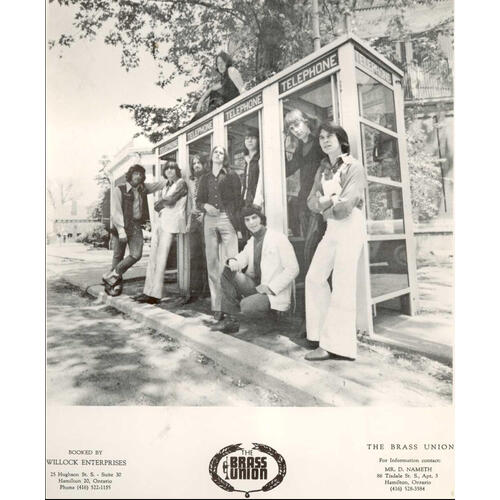
By the time the Brass Union returned home from their first Quebec City shows in the early part of 1970, the band had changed a great deal from those early days of searsucker jackets, white shirts and black ties. They had their own trucks now – a black, 9-passenger, window van and a matching white equipment van. The staging was all there, a full light show (complete with every kind of visual effect that was available back then), and a top-of-the-line sound system, board and road crew that traveled with them everywhere. Their songlist which had started out as ‘cover tunes’, copying the originals as faithfully as possible, hadbeen reworked and rearranged with the band’s imprint fully stamped on each number they did. Many of the band’s members (myself included) had their musical roots in the more ethereal world of classical music and its effects showed up fully in the band’s songs – with things like a Mel Tormé song and an arrangement of Anton Dvorak’s “New World Symphony” included in their regular songlist. The Brass Union were not the only rock band incorporating ‘classical’ elements into rock music during this time, but they were definitely one of them. And their arrangements of cover tunes and their band original numbers showed this. The band had changed a great deal in 3 years. And as Cliff Hunt mentioned just recently: “The suits were gone, the hair was longer, and the beards were growing. It was not just a visual transition but a musical and social one as well.” By the time the two trucks rolled back into the Hamilton/Burlington area at the end of February 1970, they had been playing together every night for three weeks, practicing nearly every day and spending countless hours together on the road. They were ready for the next step – releasing their own record. And it took them no time at all to do so.The band recorded two numbers at the RCA studios in Toronto in, if memory serves me correctly, a one-day session: “It Won’t Be Long” (side A of their 45 rpm record) and “Restaurant Encounter” (side B). Both songs were written by the band’s lead guitarist, Len Blum and arranged by the band. In truth, neither of these tunes were the band’s favourite originals (they had quite a few written by this time), but they were the ones that the record company felt would be the best pick for their first record. And who were these young kids to argue with proven professionals? The songs were recorded, mixed, produced and pressed rather quickly and by the end of April 1970, the song “It Won’t Be Long” was ‘chartbound’ on Hamilton, Canada’s CKOC 1150 Top 40 chart (see below). The song stayed on the chart for a number of weeks, reaching as high as No. 7 locally, at one point. As a young kid, still rather ‘green’ to the world of professional music, it was rather nice to turn on the radio at night and hear my own band playing. And with the success of this record, by the end of the summer the Brass Union had secured a show at the biggest venue available in the Southern Ontario area at the time – the CNE Grandstand Show in Toronto.
“True terror is to wake up one morning and discover that your high school class is running the country.” – Kurt VonnegutIn putting together a story about any group of closely-knit musicians who worked during the tumultuous late 60’s and early 70’s, there are a number of common factors that are nearly always found amongst the stories – someone lost through drug or alcohol-induced mishap or someone finally succumbing to that which surrounds the lifestyle that is so often associated with rock music. And although the two dozen or so people who were part of the Brass Union are not without those few who were ‘lost to us much too soon’, seemingly without exception, the ‘Where Are They Now’ part of the Brass Union story is one large list of personal success stories. The gamut of the stories of this band covers doctors, lawyers, artists, technical wizards, hi-tech people, personal business owners and yes, folks like myself who are still out there on the weekends playing Chicago Transit and James Brown music to anyone who’ll still listen.Recently, a couple of Brass Union alumni got together – hadn’t seen each other in 40 years or so – and the occasion was that one’s band was playing at the grand opening of the other’s world-class medical facility. As they sat talking after the show, in an extremely opulent personal motor coach (I might add), conversation naturally flowed toward the career, accomplishments and personal successes of what is now one of Canada’s leading cardiologists. Came the reply back to a man who now carries the job title of ‘working musician’: “Don’t ever underestimate the worth of your profession as a musician, the good it does for people to hear your band play, the power of good and healing in music. We both heal, but we do it in different ways.”The Brass Union, in their six-year existence, had a total of 19 musicians, two managers and five road crew. As much as I have been able to find everyone after 40 years, this is their story:
Vuk Kovinich was the original lead guitarist for Brass Union and one of the Aldershot High School group that put the original band together."During the mid-60’s", recalled Vuk, "we were students at Aldershot High School. Dave Balan and I played in various bands during that time – mostly together. In 1966, because of an act we wanted to put on for the school’s annual Christmas Show, a few of us formed a band called ‘The Fourth Hyrd'. Probably because there were 14 people in the band, and because it was the only 'rock' presentation, it turned out to be somewhat of a hit with our fellow students.We were asked to play at the Christmas dance that night. We had a repertoire of 3 or 4 songs, which worked out quite well. The trick was to drag the songs out as long as we could and mix the order in which we played them. The song that went over the best was 'Louie, Louie' by the Kingsmen. This was amazing because we didn’t know the words. No one cared. Paul thinks we also played a serious rendition of 'Land of 1000 Dances'. We began to practice over the Christmas holidays and this exercise kind of weeded out the players who weren’t really interested in more than the Christmas Show."By the spring of 1967, Vuk graduated from Aldershot High School and his family decided to move out of the area to Cornwall, Ontario. Vuk gave his notice to the band and stayed on until later in the fall of the same year. “My last gig was at Burlington Central High School”, he said recently. After he arrived in Cornwall, he put together another band called the 9th Street Union, a 9-piece horn band which was, in his own words, nearly the same thing as the Brass Union. He stayed with that for a few years until he went off to college.College for Vuk was first, St. Lawrence College in Cornwall, where he studied Marketing. Following that, he attended Ottawa University, getting first a B.A., then continuing on to graduate from the Law Academy. Today, Vuk still lives in Cornwall with his wife Germaine of 37 years, and has the private law practice of “Arthur, Kovanich, Barristers & Solicitors”. Most of his work these days is as the prosecuting attorney working with the Akwesasne Native Tribe. Germaine and Vuk have three grown children: a daughter, Lana, a dental hygienist; an oldest son, Vladi, in the field of labour; and a youngest son, Nik, who’s currently working on his biology doctorate. When I asked Vuk about his retirement plans, his reply was simple: “Nope. If you find a job you like, you’ll never work another day in your life.”Of course, the last question I had for Vuk was if he still played his guitar at all. “After the 9th Street Union Band broke up and I went off to school, I didn’t play for nearly 20 years. Then a group of people from church wanted to put some musicians together and I got back into it ‘big time’. It was mostly church stuff, but you know, when you’re at home, you don’t do church stuff”, he said, with a laugh. “I did that until about five years ago. I’ve got all my guitars and all my keyboards still, and they’re all set up in what I call my music room. It’s like riding a bike, you know. Once it’s in your blood, it never leaves you.”Webmaster’s Note: Sadly, while attending his niece’s wedding reception in Alexandria, ON, Vuk Kovinich suffered a fatal heart attack and passed away on July 21, 2012. He was 64. "He was the heart of our family. We are a really tight-knit family. We were brought up that way and he instilled those values in us," said his daughter Lana. "He was our rock ... I knew that he knew a lot of people, but I had no idea how many lives he had touched. “Vuk will be truly missed by all those who knew him, and especially us, the members of his band.
Dave Goodrow was the band’s first bass player and another member of the original Aldershot High School group. As Vuk recalls: “Dave Balan and I were becoming interested in the music emerging on the pop-charts – rhythm & blues from the likes of Wilson Picket, Mitch Ryder and the Detroit Wheels, Otis Redding, etc. They usually had a heavy brass influence in their bands. At the time, I was in the Aldershot concert band. We thought we could import some of our friends from the band. So, Darrell (Shotgun P. Webs) Nameth (tenor sax), Paul Goodrow (trombone), Cliff Hunt (trumpet) and Bill Magee (trumpet) became our brass section. We still needed a bass and rhythm guitar, though. Paul indicated that his brother, Dave Goodrow (15 years old, at the time), was exceptionally musically-inclined and that he could probably learn to play simple progressions well enough to get us started. He did and, of course, got better as time went on.”Dave Goodrow remembers: “The original Christmas production had 14 people in it, with lots of people playing different things, but they didn’t have a bass player. I played piano at the time and knew guitar chording. I just popped in one day and innocently said: ‘Well, I’ll play the bass’. They replied: ‘OK, you’re the bass player.’ So I went out and found a $5 hollow-body bass guitar. When we played at the Battle of the Bands later on in the year, a local music store supplied the equipment and I was given a Fender bass guitar to play for the first time. It was such a difference from my $5 guitar. Gee, I don’t have to press hard to play it.”Dave stayed with the band until the end of the school year, when he graduated Grade 13. And with a little ‘urging’ from his parents, he was faced with a decision on whether to stick with his other interest of playing football or playing the bass guitar. “I was a much better football player than I was a bass player, so the decision was easily made, and I left the band”.After high school, Dave began taking mathematics at Waterloo University, but only stayed for two years. “I was very young and really not ready for university”, he said, recently. So he left Waterloo, took some time off school, and picked up a job at the Valecrest Farm in Freelton – a local horse-breeding farm. “I always knew I’d go back to school and after a couple of years working there, I said: Why don’t I go back to school and become a veterinarian?” Five years later, Dave graduated from Guelph University with a BSc in Veterinary Medicine and immediately opened his own practice, specializing in horses – “for better or worse”, he said with a laugh – which he continues to do to this day.Today, Dave and his wife Gwen (of 14 years) live on their 75-acre farm, the Irish Creek Equine Clinic, in the beautiful Puslinch area of Southern Ontario. He has a business office in downtown Campbellville, a standard-bred race horse clinic built on the farm and yet another clinic at a very large nearby 240-horse training centre. His other interest, football, continued on to the Burlington Braves of the Ontario Provincial Football League (OPFL) and the eastern divisional championships two years in succession, then as an involvement in provincial rugby – first as a player, then as one of the top referees in the province, then managing a top division club, and now as President of the Brantford Rugby Association. His wife Gwen is a professional Human Infertility Specialist, with 18 years of post-secondary education, working in nearby, Mississauga. With the farm, the two clinics, his involvement with provincial rugby, Dave has a full life, indeed. “I stopped playing my bass when I left the band, continued on playing the piano for about 15 years after that, but haven’t played much since. I missed it for a while, but today there just isn’t the time.” Dave has ‘slow down’ plans for the near future, but no thoughts of retirement from doing what he so enjoys.
Bill Magee was one of the original four-piece ‘horn section’, recruited from the Aldershot High School band – the others being: Darrell Nameth, Cliff Hunt and Paul Goodrow. He stayed with the Brass Union, through 1967 until school was finished in ’68, when he decided to leave the band to continue on in school. “It was a difficult decision for me”, he told me recently.. “At that time, the guys were wanting to go full-time into the music business, and I decided, that I needed to finish my education in order to get a flying job. Time wouldn't allow both, so I left the band to go to McMaster University and complete a B.A. in Geography.”Bill’s other big interest during his younger years was flying airplanes. “I started flying when I was sixteen, just doing it privately”, he told me. “I got my pilot’s license then went on from there to get my instructor’s license.” By the time he’d finished at McMaster, Bill landed a flying job with Air Canada (pun intended, of course) working first out of Montreal, then Toronto, where he flew commercial airplanes for about 15 years.By the mid 80’s, Bill moved away from the Southern Ontario area to be closer to his son, who now lived in Vancouver, settling first in White Rock, B.C. He stayed there for 10 years before finally moving to Courtenay on Vancouver Island, where he and his wife, Diane, live today. Bill has three children: Matthew, Michelle and Alex.“For the last 10 years of my flying career, I was flying mainly to Europe, and Asia. After 33 years of pushing heavy metal around the world, I took an early retirement package and left the airline in 2004.” I asked Bill about his music, if he still played. “It’s hard to play trumpet on your own. After the band, I was busy with school, then my career, and playing the trumpet just faded away. There is a fairly active music scene here in Courtenay. I haven't played since I left the band, but I still like to go out for a few cool ones and listen to the entertainment.”Today, Bill and Diane are happily enjoying their retirement years on the beautiful British Columbia coast. “My wife and I are into motorcycles, and have taken several trips up and down the west coast. I also enjoy the outdoors here. Fly fishing, trap shooting and photography occupy some of my time, as well as fixing up the older house that we are living in.”Yes Bill, it sounds as if life has been good.
Dave Baylis joined the band late in 1967, replacing Dave Goodrow on bass guitar, who had returned to school. To say that Dave added ‘pure slapstick comedy’ to the band (as is stated in the band promotion of the time) could almost be called an understatement.Cliff Hunt recalls: “What I remember about Dave is that he was one of the funniest people I’ve ever known. He and Bruce Wilson were the band’s comedy team. We would get in the van to go to a gig and these two would start, and it was like ‘Second City’. They would ‘jam’ on an idea. They’d start it up, one time as farmers, the next, as mechanics, and we’d drive for hours while these two would put on these ‘personas’. They’d play off each other, improvising, everything done spur of moment, and this would go on for an entire two-hour road trip. It was unbelievable to watch and we were sick by the time we got to the show because we couldn’t stop laughing. And that’s the most important thing he brought into the band. He had an amazing personality.”Cliff went on: “He and Bruce were in the same class at school, a few years younger than us older guys, and they generally sat together at the back of the van and they’d just ‘go off’. And it got to the point where we’d start them off – we’d think of a scenario and get them going and you didn’t have to listen to the radio or anything all the way to the gig. It was just total entertainment all the way.” Bruce Wilson remembers: “It was all ad-lib, situational humour – whatever the situation we were in, we’d try to have some fun by doing something with it. I talked with Bill Hughes about Dave, recently: “Dave was a caricature of a comedy guy. He was hilarious. Whenever you needed a laugh, you’d just turn to Dave Baylis and he always had something that fit the moment. He was a very kind person, and his comedy was never done at someone else’s expense. He didn’t make fun of others, but instead would take a situation and find something humourous about it. But he was a bit of a dichotomy as a person – outgoing and funny with the band, but as a person he was very private. Once the show was over and we dropped him off at home, I didn’t know a thing about him until we picked him up for next practice.”Most of the band members could tell me very little about Dave on a personal level. After he’d been in the band a few years, he was sitting at his dinner table one night and his mother noticed a lump in his throat. Shortly after, he was diagnosed with Hodgkin’s Disease (cancer of the lymph nodes). He never mentioned this to anyone in the band, but he did leave the band to receive full treatment for his disease. Bill Hughes recalls: “None of us knew why Dave left the band. We all found out ‘after the fact’ about his medical problems. Unlike some other people, when Dave left the band, he left the band and we never saw him again. He didn’t come out to the shows or any of the parties. He never tried to maintain the ‘connection’, that I can recall.”Information about Dave after his band years is very sketchy. I do know that he did have an operation to remove his lymph glands shortly after leaving the band. As Terri Anders recalls: “I remember him coming to our house one night to tell us that he had cancer, saying how he felt about it all. When I hugged him, he broke down and said that I was the first person to do that. It seems that all of his friends had kept away from him, thinking the cancer was catching! In those days, there was a lot of ignorance regarding the disease.”Dave’s cancer did go into remission for many years and he went on to study at McGill University and eventually enter the field of medical prosthetics. Some sources have told me that he went to Vancouver for a while, and others have him working in the Hamilton area in his chosen profession.Unfortunately, about 10 or 15 years ago, Dave’s cancer returned and he lost his battle with it. But the memory of Dave Baylis and the remarkable person that he was stays with all of us to this day.
I sat and talked with Dick Citroen last summer for a while in his backyard, and as he was when I talked to him just recently to gather this information, he was a wealth of stories and ideas. Even 40 years after he worked with Brass Union and nearly two decades after he’s officially retired, he’s still the same man he was when he took a group of high-school kids and instilled stage presence and professionalism into their musical lives.Dick linked up with the band about half-way through their first year, and stayed for about two years. Under his tenure, the band were fitted with their ‘stage clothes’: searsucker jackets (one white, one black), with matching pants and shirts. The staging was built: rather unique (for the time) curtained, elevated platforms housing the four horn players and the 3-piece rhythm section, which went with the band to every show. During this time, the band entered a number of “Battle of the Bands” contests and won every one of them. Promotional ‘packages’ were put together, with band pictures, bios, business cards and press releases. When the band opened for Del Shannon (their first ‘paying’ gig), Dick made sure that the Brass Union had their own ‘billing’ on the poster – even stipulating the size of print. Different ideas of what to do when on stage and off, getting proper vocal training and generally, how to compete in the rather competitive world of entertainment were all brought to the band’s attention by Dick. After two years had passed, the role of Brass Union manager had become more that of a booking agent – which had never interested Dick – so he and band parted ways.Before, during and following his work with the Brass Union, Dick has always been active in the entertainment industry in a managerial capacity. Within a few years after leaving the Brass Union, he opened his own agency, Four Arts Productions – among its credits being the Canadian representation for NEMS, the British agency that covered most of the British bands crossing the pond, including the Beatles. Four Arts worked with agencies in Los Angeles and in Canada 'packaging' a number of middle-of-the-road variety shows and tours – the Pig & Whistle Show, the River End, Diamond L’il, Vera Lynn’s cross-Canada tour, etc. He stayed in this business for a number of years, before finally leaving the entertainment industry to finish out his career in different sales and managerial capacities. Dick has now been retired for number of years and still resides in the Hamilton area with his wife, Sandra. He has two daughters and a son who’s appropriately in record production.Dick now is enjoying his retirement years, caring for his half-acre garden, drinking good wine and listening to a lot of music (in his own words). When I visited him last summer, the speakers were on his back patio, with a constant flow of some excellent big band jazz filling our talk. As I commiserated (somewhat) at the state of the entertainment business today, we had a great in-depth talk as he gave me his ideas on how to fix the various aspects of the business. Yes, in forty years, Dick Citroen is now long-retired, many years out of the entertainment business, but all his ideas are still there. “Maybe I’ll do something about it all, some day ... when they make me King of Canada”, he said, with a laugh.
Dave Balan was the band’s first drummer and one of the main members of that first Hulse’s Heroes Christmas show. By the time of that 1966 show, he could be called a ‘seasoned’ band member, as he’d already been part of two other bands: the Malibus (with Johnnie Lovesin) and Little Brutus & the Assassins. Dave stayed with the band until the school year was over in 1969, when the parental pressures that, I suppose, we all felt to some degree during those days forced him to make a decision. In a nutshell, the Brass Union went looking for a new drummer and Dave was able to still remain living ‘at home’. But Dave has no regrets: “Because of that, and what happened ‘after the fact’, I was able to work in the [recording] studio, and those were great years for me.”Dave has stayed involved with music, either playing it or working with it, his entire life. After he left the band, he worked in one of the larger advertising agencies in Toronto for a while, starting in the mail room and working his way up to Network Television Supervisor. But music was where Dave’s interest lied and after a few years in advertising, he used some of his business connections and got a gig working for RCA Studios. “I had totally forgotten that we [the Brass Union] had recorded our first demo there and was reminded of it when I found the tape in the vault. When I went to RCA”, he continued, “the only thing I knew about recording was ‘erase, playback and record’.” But 15 years later, his resume spanned recording engineer work at RCA (which later became McClear Place Studios) and a number of freelancing sessions at Manta, Sounds Interchange and many other studios. “I did a lot of, and quite the variety of, recording sessions. I also designed and built the first version of Chalet Studios near Uxbridge and ThinkMusic studios in Toronto," he told me, recently. Dave also organized and taught the first audio recording course at the Trebas Institute in Toronto, as well as a number of varied engineering projects: a Bill Cosby production at Hamilton Place, the sound track to an Elke Sommer movie, an Oscar Peterson album, to name just a few.These days, Dave has run full circle and is now working in marketing for a Digital Imaging company in the new McMaster University Innovation Park in Hamilton. He still lives in the Burlington area, just a few miles from Aldershot High School and has one 27-year-old daughter, Jessie, who works for a Toronto communications agency. Musically, Dave is still playing around every week – although his original Rogers drums (which he still has) have been replaced (mostly) by a ’67 Custom Fender Telecaster guitar. “After the Brass Union, I didn’t have any ‘need’ to play drums, and after I started playing in jam sessions, I decided that they were too much trouble.” Dave’s now jamming regularly every week with a group of up to ten people and has been doing so for over 20 years – plus the odd Open Mic, office jam or party. I ran into Dave indirectly last summer in a studio where I was recording some horn parts for another Brass Union alumnus. He’d been in a while earlier, laying down some drum tracks.As you can see, Dave’s doing very well for himself, still fully involved with music and still doing occasional audio work (studio, live, acoustic consulting) on top of his regular job in marketing and his jam session/band stuff. "It was a formidable time in our lives and in the music industry and its history, and to be part of it in the Brass Union was great."
Mike Thornton joined the band in 1969, replacing Dave Baylis on bass guitar and was a member until early 1971. At the time, the band had decided that they were going to go ‘full-time’ as musicians and Mike, with a full-time job as an apprentice machinist and an avid fishing hobby, just couldn’t give the time needed for the band, and the decision was made. I talked with Mike recently, and in his a laid-back style that I still remember from last seeing him forty years ago, he said: “That’s life. Things happen ... and that’s OK.”After the band, Mike went on to finish his Machinist Apprenticeship then worked in the industry at Hamilton giants like Dofasco and Stelco for 40 years, until recently semi-retiring. For the past twenty-five years, Mike has also been found at a number of the Mohawk College campuses in the Mechanical Technology department, working on their machines, both in repair, maintenance and taking on teaching assignments. Even though ‘officially’ retiring a few years ago, he still ‘keeps his hand’ in his chosen profession, filling in for friends in their shops when needed.As far as his music is concerned, Mike could be called a career working musician – carrying a ‘day job’ through the week, practicing one weeknight a week and playing gigs on the weekends. “I’ve never stopped playing”, he said. “After the Brass Union, I linked up with Vehicle [another well-known Hamilton band] for a while, then spent about 15 years with another local group, ‘the Midnights’. I then went on to other bands: country bands, rock bands, dance bands – I’ve always continued to do music.” Mike’s current project is a five-piece jazz group called ‘The Empire Jazz Quintet’, who play semi-regularly in the Hamilton/Cambridge/Cayuga areas. Forty years later, the music is alive and well in Mike Thornton.On a more personal level, Mike has a daughter Georgia, a son, Cole, two grand-children and still lives on Hamilton Mountain with Carolyn, his wife of three years. As you can see, Mike is still happily involved with his main hobby, fishing – “One of my catches from Long Point last summer”, he said. Also, Mike is heavily involved with a number of activities in his church “Mainly in the “Outreach” areas”, he said. “I run all the youth dances, supply the music – on a DJ level, since I know the music. Also, we have a large social club that always has live entertainment of some type – skits, that kind of thing. My wife, Carolyn, plays the piano, so we’re always involved with things like that.”Mike’s had a full life, is thoroughly enjoying his retirement, and is still fully involved with his music – just like he was when I last knew him, forty years ago.
Paul Goodrow was the original trombone player and the only member of the Brass Union to be in the band twice. He was one of the four original horn players recruited from the Aldershot High School band after the 1966 Christmas show. Paul, like his brother Dave (above) was getting a fair amount of parental pressure about the idea of becoming ‘full-time musicians’, so as he started his final year of high school in the fall of 1967, he made the decision to leave the band. He returned briefly a few years later, after graduating high school and entering the McMaster business program, but only stayed a bit less than a year. “I was restless with school, so I took a two-year leave, and the band was one of the things that I did.”Paul did return to McMaster University and studied Commerce. He graduated with a BComm in the mid 70’s and by the early 80’s he had his MBA. During the 80’s, Paul worked in corporate banking for the Bank of Nova Scotia. By the early 90’s, Paul left the bank to establish his own business. “I was always more entrepreneurial than the bank, especially in the notion of ‘time’. Where the bank would suggest to do something in two years, I would think ‘why not do it in two days?’ So I left and established my own Corporate Finance and Corporate Development Consulting Business.” Over the years, his work has involved corporate finance consulting with small brokerage firms, involvement with early stage public companies and for the last ten years his focus has been in the renewable energy industry. And in this latter focus, Paul has recently formed his own development company, concentrating on strategic development in the renewable energy industry. “Over the years, it’s been less banking and finance and more working with inventors and developers to position their companies so that investors will find them attractive.” I will admit, it was quite fascinating talking to Paul (a fellow trombone player) about his corporate life – something of which I know very little. As Paul himself commented: “It’s interesting. It’s creative. No one year is the same as any other.” Today, Paul has moved away completely from the ‘consulting’ aspect and is devoting his efforts solely to his new project development company: Carbon Cycle Energy. “We’re currently in the process of developing a number of projects in Canada and the U.S. in the renewable energy field.” I asked Paul about retirement plans and he said: “Not in the foreseeable future. I’m having too much fun.”Paul and Carol, his wife of 33 years, have one 28-year-old son and still live in the Burlington, Ontario area. I asked Paul whether he still played his trombone at all. “I haven’t played since I busted my lip playing football.” He does admit that he misses it though, but with his wife singing with (and as a founding member of) the John Laing Singers – a world-class chamber choir – he does still get a great deal of music in his life. “It’s funny,” said Paul, “how the era of the band affected people. I was talking to a friend recently, someone very much into the classical music field, and it came out in conversation that I once played in the Brass Union. To see the change in her personality when I mentioned this, and listen to the story she related of ‘sneaking out’ one night to go hear the band as a teen – it was quite amazing, really. And although we’ve all grown up and gone on to build full and interesting lives, the band still has its fans. Even now, looking back through the filters of four decades, careers, families and complete life changes to when the Brass Union was out playing its music, those times still hold a special place in our memories."That they do, Paul.
Dave Thrasher is the Brass Union member who’s arguably logged the most miles into his personal life – from the Hamilton/Burlington area, to Vancouver, back to Toronto, to New York City, then to the British Virgin Islands, and finally, to Thailand where he resides today. Researching his professional life has certainly not been just a simple phonecall.Dave left the band in 1971 to study animation at Sheridan College in Oakville, Ontario. He began work immediately after college with the National Film Board and was one of the first artists to work for Nelvana Ltd. – one of Canada’s largest animation companies for many years. Through his work with Nelvana, he traveled to the Orient a number of times, doing ‘series direction’ work for projects that they’d acquired from Lucasfilm. He then went to Vancouver for a few years, came back to Nelvana, then moved to New York City to work for Rankin Bass. “That was the beginning of my ‘storyboard’ days that would last for 15 years,” he said, recently. The next stop for Dave was the British Virgin Islands, a new life, a new career, and further development of his own talents as a professional artist. Much of his work (and life) there can be found on-line and in his Facebook account so I’ll not repeat it all here. But in a nutshell, he opened his own Art Gallery on the Islands – many of the paintings can be found on this site – and put on regular shows with prominent artists like David Carson & Fredrica Craig. And from the Islands, he has recently moved to Thailand with his wife Anne, where he lives today. Dave has three sons: Sunny, age 37 who works in Canada at Chorus Television; and two younger sons, Damian, age 11 and Ariel, age 10 who live with their mother in the Virgin Islands.Like he was during his Brass Union days, when he was known as much for his dancing ability as he was for his vocalist/front man skills, Dave’s life has been two-fold. On top of an extremely varied career in the artistic world -- working as an animator, layout and animation directors, a storyboard artist, developing his personal artistic career and now teaching in Thailand – Dave has also stayed very active with his musical interests, stepping on stage or working with the local musicians everywhere he’s gone. He started playing the blues harp (harmonica) right after the Brass Union and has now been at it for the last 37 years. That together with his singing, it has had him working with musicians like: Keith Richards, Avashai Cohen, Kacey Cubero, The Belairs, Reverand Raven, Eric Stone, Jeff Ross, Buddy Cage, Cyro Baptista and Maxx Cabello Jr., just to name a few. He sent me a recording of some of his recent work and I must admit, it was excellent, with a very solid groove to it. While in Seoul during his early years he played with musicians on the army base. He played in a number of clubs in New York including the Dan Lynch Blues Bar, and on the Islands he landed a steady gig with Ruben Chinnery (who is a real institution there) – as well as sitting in with many of the musicians as they passed through the area.Everything in Dave’s story is a near equal blend of his first love, art, and his second love, music. He’s now teaching English and Art in Thailand (see picture to the right), where he lives with his wife Anne. “Music has always been a driving force for me which I can’t live without. But I am a visual artist at heart. I have been drawing since before I can remember and have always known that I would wind up doing something in art. So working in bands when I was young was a great adventure into a related side of myself that will always remain my favourite hobby. Because let's face it, once you've been bitten by the stage thing, it never lets you go.”Aaaahh yes, Dave – words that we all understand very well.
uit Boy foundation. It was non-stop top-level bands all night, and there was Herb off in a corner, smiling, enjoying the music. I made an opening joke about him being out drumming up some business for himself, and he replied: “No, I retired from that long ago. I just like coming out seeing the guys, seeing what they’re up to now. It’s just an enjoyable night out for me.”Herb Lock was a little different than most in his profession. He wasn’t just the Brass Union’s booking agent. He was also a friend.
There was a time before my years in the Brass Union when I believed that this was the extent of the road crew’s involvement with a rock band. They’d be at the gig to do their jobs long before I was, be done by the time I arrived, and when I was finished and was ready to go home, they’d be back later on for ‘load out’. The band was one thing, the road crew was another – or so I thought.Long-time Grateful Dead roadie, Steve Parish, in his book Home Before Daylight, tells how he and the band hung out together, played together and partied together. “Life with the Dead was tender and heart-felt. Garcia was a brother to me,” he says. “And I took my job as a sacred task.” One evening, Parish got word his wife and daughter died in a car wreck. “I was out of control. It was just an incredible world. We always had a connection with death, and it made you tougher. The band literally moved in with me. They took care of me.”Many bands have given full credit to their road crew on their album jackets and the jobs that they do. The song you are listening to is Jackson Browne’s 1977 tribute to his ‘roadies’. Pink Floyd showed their road crew on the album jacket of Ummagumma and recorded them speaking on Dark Side of the Moon. My current band has a nine-person band picture – eight musicians and one sound engineer. And as Cliff Hunt mentioned to me recently: “When you speak of roadies, there is Howard Ungerleider, who started with the band Rush when they were playing The Gasworks, a bar on Yonge Street in Toronto back in the 70’s. He has remained with the band for over 35 years, has become an integral part of their organization, and is one of the most sought-after and highest paid lighting and stage designers in North America.”The Brass Union, in their six-year history, had two road crews – the first one: two guys, George Hamor and Bill Hughes. Once the band became a bit more ‘theatrical’ and specifically, once the equipment included a ‘sledded’ Hammond B3 organ with a full-size stage Leslie, the two-person crew was replaced by three. This is the story of those five people.
For the first year or so, the band members dealt with their own equipment and had different people come in – friends and such – to help during the shows. But by the time 1968 rolled around and the band had become a bit more serious about their place in the music business, it was time to hire a ‘dedicated’ road crew to be part of the band. Bill Hughes was the first member of this crew.I talked to Bill recently about his role with the band. “People referred to me as the road manager, which was actually true to some degree. I was interested in timing, logistics, transportation and making sure everything was where it was supposed to be. At the shows, I ran the light show – [which for this band, was a rather large task], but outside the shows, my place was more organizational – a bit of work on finances, cheques, bills, payments, acquisitions of things that we would need on a daily basis like lights bulbs, fuses, truck maintenance, stuff like that. We had an account at a local hardware store and I was in there every day picking up something.”When the band decided to go ‘full-time’, Bill ran into the same problem that a number of us had run into: “My parents kicked me out of the house”, he said, rather matter-of-factly. “I was told to get a haircut and go back to school or leave home. From the day I left school and Bruce [Wilson] and I drove the band trucks around to the front of the high schools, picking up the different guys as everybody cheered, I lived in the white band truck for the next three months.” Bill got his own place and stayed with the band for another couple of years, but eventually, it was time for him to leave. “I liked where the band was heading with the Fairytale and different creative directions, but there was a lot going on with the band that I didn’t agree with – specifically, the record company's choices for the two songs on our 45 rpm record. I thought the songs were musically good and interesting but the lyrics potentially insulting to our fans and listeners. I took pride at being a problem-solver and it came to a point that I’d reached the end of the line for what I thought I could contribute to the band.”After leaving the band, Bill returned to school to finish Grade 13 and began working for Herb Lock, booking the band as much as possible. Two years later, Bill was accepted at Brock University, and by attending two universities at once (Brock and Trent), he was able to complete a B.A. in Psychology in 18 months. “I drove from Peterborough to St. Catharines three times a week.” From there, Bill went to Wellandport to become the Director of a Residential Treatment Centre for Learning Disabled Children. Two years later he was off to the University of Toronto to complete a Masters Degree in Education. From there, he completed the three-year McMaster medical program and was accepted into the Internal Medicine program, studying first at McMaster for 2 years, then at St. Paul’s Hospital in Vancouver for 1 year, then back to Hamilton for 2 years studying cardiology, then back to St. Paul’s as a ‘teaching fellow’, to finally, his move to Peterborough to start his own practice.Today, Bill Hughes is known as one of Canada’s leading cardiologists. He’s just recently opened his new 60-staff Kawartha Cardiology Clinic in downtown Peterborough. Bill’s inherent talents in organization, problem-solving and specifically, human kindness, have put him at the forefront of significant innovations in the medical field. When he came to Peterborough in 1984, there was no cardiology program in the area and he saw the opportunity to be a ‘builder’, to the point that his program is now recognized as one of the most well-coordinated and efficient in Canada. “We have a vascular health network, which is an innovative, co-operative effort between doctors and specialists that I started in 2000. We’ve leveraged that into a new program, supported by the Ontario Ministry of Health that sets out to create a structure to detect and treat vascular disease at a very early stage. In essence, those that would be at risk for heart attack and stroke, don’t actually have them.” This is a unique program that Bill devised that is being implemented throughout the region. And just as Bill was during his years with Brass Union, his life is about problem-solving, planning and organization – making sure people have what they need, when they need it.Bill and his wife Jennifer (of 26 years) live on their farm in Peterborough, Ontario and have two girls: Alexandra, 25, who lives in Chicago and uses her Fine Arts Masters Degree training at one of the Art Galleries associated with inner-city Chicago; and Kathleen, 19, who spent her high school years promoting bands and organizing concerts and is now at University of Toronto studying Psychology and Biology. Bill’s wife Jennifer is a nurse by training and now, a pacemaker and implanted device specialist who was the founding President of a world-wide Association in pacing and device care and is the only non-physician to receive a lifetime achievement award from the North American Society of Pacing and Electrophysiology.Musically, Bill is still very active as well. “We have a folk/country band called Burnt River, where I play guitar and sing. We play locally whenever we can, but we’re scattered about quite a bit, so it’s not as much as we’d like. Our bass player’s in Calgary now, so that’s a bit of a challenge for us”, he said with a laugh. “It’s fun. Some of us have been playing together for 45 years now.”The different members of Brass Union have all left their individual ‘marks’ in the world. Bill Hughes is certainly no exception.
George Hamor joined the band as the second member of the first road crew, shortly after Bill Hughes in 1968. George knew Bill through the Y.M.C.A. Summer Camp and work that they’d both been doing, opening up “Pillar Square” – a drop-in centre in the basement of the James St. South Y.M.C.A. in Hamilton. “Bill knew these guys that had put together a band and were looking for a place to practice. We’d just put together Pillar Square and that’s how I began my involvement with the band.”George’s role with the band was taking care of the ‘sound system’ and keeping all the equipment running. At the shows, George would be behind the sound board and Bill behind the lighting controls. George also built a lot of the sound system himself. “Yeah, we cobbled together what was, for then, a reasonably advanced sound board for the limited budget that we had.” And in an incident that I, as the trombone player, will probably never live down, George remarked: “What was the most interesting part of the four Bogen power amps going up in flames at a show in Quebec City was not the flames coming out of the amplifiers but that next day, we were in Quebec City trying to find (with our rudimentary French), first a place that had parts, and then getting people to understand what I wanted. But we found the parts, rebuilt it, and were ‘good to go’ the next night.” I personally, of course, have no further comment about this incident.The biggest thing I remember about this two-man crew is the feeling of confidence I had on stage, knowing that everything was ‘covered’. If problems arose during the show and they were humanly possible to solve, one of these guys would be ‘on it’ – often on stage, replacing, adjusting, etc. as the show went on. It makes for a better show when the stage performers only have to concentrate on their own performances.George left the band in the summer of 1971 to go back to school and complete an Electrical Engineering degree at McMaster University. After McMaster, George moved to Ottawa and began working at Leigh Instruments as a Professional Engineer, designing electronic systems for aircraft. George worked there as a Project Engineer, designing avionics equipment. The company went bankrupt in 1990, and from there, he moved to CMC Electronics (what was then, Canadian Marconi), where he is today. Over the years, George has moved up the corporate ladder from the design and development of avionic control and navigation systems to today, acting more as a Program Manager, overseeing 10 to 20 million dollar projects for the military and commercial markets. I asked George about his retirement plans and he said his plans were to retire within the year, and yes, he is definitely looking forward to it.On a personal level, George and his wife, Anne of 31 years, live in the Ottawa Valley area of Ontario and have a son Alex, who continues on in university, now working on his second degree. During the summers, George and Anne are found at their cottage, and during the winter, George plays both hockey and curling. As to his musical interests today, he says: “I still enjoy the old rock music – to my wife’s dismay – play the guitar a bit up at the cottage, but that’s about it for me.”I noticed, in collecting the information for this story, the efficiency and accuracy that I remember from him from back during the band years. The interview flew by, taking half the time as anyone else. I asked a question and the answer was ‘right there’, just the same as it was when I would signal him from stage, 40 years ago. Yes … you could definitely say that George Hamor is still the same old George, and he has built an excellent life for himself.
Rick Moses joined the band a few months before Brad Stone (below) in 1971 when Bill Hughes left to return to school. He was the first member of what would be the final 3-person road crew and he stayed with the band until the end.After the Brass Union broke up, Rick stayed working with bands. “I got involved with a 12-piece band called 'Young' – a band which included eight Berkeley-trained horn players: 4 trumpets, 3 saxophones and 2 trombones. We went to Florida a couple of times, Vegas, things like that.” After that, he linked up with Brad Stone again in a local band called 'Wednesday' and stayed with them for a number of years. Then it was off to another well-known local band, 'Vehicle'. After Vehicle, Rick and Brad linked up again for a while with the 'Cooper Brothers Band'. During this time, Rick was mostly the sound engineer, both at live gigs, in the studio and on the road. But by the time he was working with the 'Lydia Taylor Band' in the 80’s, he was also road manager, in charge of the finances, as well as his regular sound engineer work. “I did a lot of studio work and a lot of touring during those years. Altogether, I’ve been to Vancouver at least a dozen times. On one band trip in the 80’s – I think it was with Lydia Taylor – I was driving home through the Rogers Pass near the Alberta/British Columbia border and there was another truck coming the other way. Just as they wentby, I glanced over and saw that it was Brad Stone. We both slammed on the brakes, backed up and did the big greeting in the middle of the road. His band from the east coast was just heading out to the west coast on tour.”By the mid 80’s, the music business was going through a bit of a lull. Rick had settled down somewhat, gotten married and he and another musician-friend decided to take the summer off working with bands and go work in the construction business. “Of course, once I started doing that,” said Rick, “and saw that the money was much better, I stayed with it – to the point that I now have my own construction business. You know me – I’ve always liked to be self-employed.”Rick and his wife Cindy, of 17 years, still live in the Hamilton area. I asked Rick if he missed his time working with bands. “Well, I do and I don’t. I miss the touring and I miss the fun, but I certainly don’t miss the money.” He did mention though that during his band years, he‘d had a fairly large sound company of his own, but about the time he decided to get out of the music business in the 80’s, that it was also the time that sound equipment entered the digital age. “I became outmoded in (basically) an instant. I think I lost a few hundred thousand dollars worth of equipment because it became useless – nobody wanted it.” As far as still playing his bass guitar, which was what he was doing when he joined the Brass Union – that is now part of the past due to arthritis in his hands. “That’s why I became a sound man, actually. My fingers just wouldn’t move fast enough to play the bass anymore.” But he did say that now that he’s scaling back his involvement with his daily construction business, that he’s thinking of returning to sound production work. “I realize that I have a lot to catch up on. I’m computer friendly, but I’m not digitally hip.” Rick’s already been talking to a number of friends in the business about this, and the plan over the next few years or so is to scale back on his construction business and scale back up on his re-involvement with the music business.So after 40 years, Rick’s still the same Rick Moses – laid-back and very easy-going, with a sense of humour that will sneak up on you if you’re not expecting it. Rick has retained his music interest, gone off and built a good career and life for himself in an area outside of music and is now planning on heading right back to where I last saw him – behind the sound board. And I hope to see you there very soon, my friend.
Brad Stone joined the band at the beginning of the summer in 1971. Rick Moses and Brad had played together in bands in high school. One of those bands included Daniel Lanois (U2 Producer, among other things) as the guitar player. Through Rick and Brad’s involvement with Pillar Square in Hamilton and the Brass Union, Brad was hired originally to replace George Hamor on the sound board, but eventually ended up running the light show. The band was now involved with work on their Fairytale production and Brad had just completed a two-year course at Niagara College in Theatre Arts and Technology. His knowledge of theatrical production became invaluable to the band as they put together their Fairytale show. After 6 to 8 months, Brad left to do sound for King Biscuit Boy for a few months and when he returned, Rick Moses was on the sound board and Brad took over lighting and special effects. The two worked their jobs interchangeably until the end of the band. I suppose Brad’s greatest contribution to the band was his knowledge of special effects from his Theatre Arts training – magic tricks for John Willett to use as the Magician in the Fairytale, exploding flash pots and smoke effects, different special lighting effects, etc.When the band broke up, Brad stayed behind the sound board, moving immediately to another excellent local band, ‘Battle Axe’, Rita Chiarelli’s then band. After that he went to, ‘Mara Loves’, then ‘Wednesday’, continuing to work as a sound tech with bands full-time until he took a ‘day job’ at Dofasco in Hamilton in 1984. He stayed working there in the Quality Control Inspection Department until his retirement, one year ago. Today, Brad and his wife Hope, of seven years, live in Frankford, Ontario. They have six children: Jon, Josh, Alisha, Jaime, Chelsea and Rutger (ranging in age from 30 to 18) and five grand-children. Musically, over the years, Brad has stayed as active as anyone. Two years after he started Dofasco, he linked up with two other Brass Union members who were forming an 8-piece horn band very similar to Brass Union, and stayed with them for over 20 years working behind the sound board. In the 1990’s, he joined up with a couple of Dofasco employees and another Brass Union alumnus and formed a country/rock cover band, Common Ground, working out of the Waterdown/Hamilton area. The photo at the top left is Brad playing bass guitar during those years. Their story can be found elsewhere on this site.Although retired now, Brad continues to stay as busy as is possible, really, for one individual. I asked him recently, what he was up to these days, and he replied: “I’m ‘first call’ for live sound at the Stirling Festival Theatre in Stirling, Ontario, the ‘front of the house’ engineer for “Fiddlers on the Trent” (an annual Fiddle Festival that has raised over $120,000 for the Canadian Food Bank), the ‘front of the house’ engineer for the Frankford Blues Festival.” He continued, “I do all kinds of church and school events, festivals, that kind of stuff.” Performing wise, he is also the resident bass player at the 1802 Station Fiddlers in Stockdale, Ontario and the bass player in another local band called: “Just Another Band”, a British Invasion/cover tune band. He also works part-time at the Riverside Music store in Trenton, doing repairs, sales and a bit of guitar teaching. In non-performance roles, he’s the technical director of the Bay of Quinte Community Players Theatre and he’s done a number of other freelance things, including work with the Belleville Players. And, if that wasn’t enough, Brad’s the resident Santa Claus for the Frankford Christmas Parade every year.The above paragraph lists just the things that Brad’s been involved with since he moved to the Frankford/Belleville area of Ontario a few years ago. My recollection of him in the Hamilton/Burlington area for the many years before that was that it was difficult to go anywhere where there was good music without finding him behind a sound board somewhere. I’ve worked with Brad in a number of music projects, both as a bass player and sound engineer (and often, both). His well-above-average cheerful disposition, professional-level attention to detail and inherent love of anything to do with the artistic community will, no doubt, keep Brad involved with the things he loves to do for many years to come. And I think it would be safe to assume that Brad has begun involvement in, at least, one new project in the time that it has taken me to write his story.Yes, indeed … a full and enjoyable life for Brad Stone.
Peter Hume (a.k.a. ‘Humble’) was a giant of a man in every way, even early in 1971, when at the age of 15, he first started showing up at some of the Brass Union shows. One day, while the band was playing in front of Hamilton City Hall, Peter walked up to the sound crew and said: “I’m going to start working for you guys.” At 6 foot 6 and over 300 lbs, it was hard to argue. At the end of the show, he was true to his word and went to work immediately. The large P.A. speakers that we used back then (5’ high x 3’ wide x 1’ deep), that the band members struggled with two at a time to carry to the truck, were picked up by Humble with two hands and thrown into the back of the truck. The Hammond B3 Organ was moved usually with 3 band members on one end and Humble on the other. This alone would have been enough to cement Peter’s position in the band, but he was so much more than that.The stories of Peter’s personality and exploits with the Brass Union could fill this page alone – things like his arm-wrestling all the locals when the band played in Detroit and never losing, stories like his usual order at diners where we would stop: ‘Twenty orders of toast, please. That’s all.’, his standing to the right side of stage each show with his arms crossed and never having a problem with band security, stories of him getting on stage a few times with the band to sing James Brown tunes to the complete delight of the audience. Peter’s personality was as large as he was. But more than this, he was a gentle man, with a deceptive sense of humour that would often leave people in fits of laughter.I remember one night specifically in 1971. It was the middle of the summer and I and about a dozen other people were in the livingroom of a house in what is now the trendy Hess Village area of Hamilton. The television console was across the room under the open bay windows and we were all watching it with all the lights out and the colour controls and contrast turned up full – we used to do such things back then. Right in the middle of a rather ‘creepy’ movie, Humble’s head rose slowly up from the back of the television (complete with his huge ‘afro’ haircut) as he slowly uttered a “GUUD E-E-EVENING”. People jumped, the women shrieked, everybody screamed until we realized that Peter had stopped by and stuck his head through the open window. That was Peter Hume – always larger than life, always being there with something that you’d never forget.After the Brass Union broke up, Peter stayed working with bands for a while: first with a west-coast band called ‘Privilege’, then with local talent ‘George Olliver’, to finally working as a driver and bodyguard with Bruce Springsteen. He also linked up with another Brass Union alumnus, Len Blum, and got a bit part in his new movie, “Meatballs”. He played the part of ‘the Stomach’, uttering the line that perfectly suited his real-life character: “What? No mustard?” By the late 1970’s, Peter headed off to school and received a B.A. in History from Wilfred Laurier University in Waterloo, Ontario. Next stop was University of Toronto for, I believe, a teaching accreditation. During this time, he was also very active in athletics. He played professional football in the Canadian Football League with Winnipeg and Toronto for three years, was national university wrestling champion in 1977-78 and in 1980, he was named to the Canadian Olympic wrestling team. Unfortunately, that was the year of the Olympic boycott and Peter was never able to perform on the world stage, but he did move to Concordia University in Montreal as a wrestling coach and by the next Olympics, 7 of the 10 wrestling spots on the Canadian team came from Concordia. Everywhere Peter went, he brought his energy, his drive, his work ethic, and, most of all, his sense of humour.In 1987, Peter married Karzi McCallum and moved with her to Upstate New York. He completed a Masters in Education at Castleton State University in Vermont and began teaching in the area at a number of locations before settling at Schuylerville High School in the Mechanicville area of New York State in 1999. He also opened a piano repair business in town with his step-son Sean,specializing in repair of ‘high end’ pianos for an international market. Peter also has a daughter Heather who resides in Toronto, Ontario.Unfortunately, on October 22, 2007, Peter Hume unexpectedly passed away in his sleep from natural causes. "The whole school was crying," said 10th-grader Jenifer Wolin to a local newspaper. And district superintendent, Dr. Leon Reed, announced that hehad deployed a crisis team to help students and teachers cope with Hume's death. I’ve included the local news coverage of his passing in the clip to the right – please be sure to turn off the mp3 player at the top of this page before activating this clip, if the music is still playing. John Willett has stayed close to Peter throughout their lives and had this to say recently: “Humble was like my brother. His loss was one of my greatest losses. He had a huge heart and was a good friend to have – loyal, protective and caring are just a few of his many attributes. He never stopped riding his beloved Harley and he was one of the world’s best story tellers.”People often wonder how such a large man could carry the nickname of ‘Humble’. But it wasn’t just his nickname, it was what he was. And what he was, was impossible to ever forget.
I’ll take a moment here to step away from my narration role and speak on a more personal level. The following nine members were the ones who were with the band up until the end. They range from Cliff Hunt, Darrell Nameth and Bruce Wilson, who were the only three members to be with the band from start to finish to Bruce Ley, who was the last joining member in 1971. Together with their agent, Herb Lock and the three member road crew of Rick Moses, Brad Stone and Peter ‘Humble’ Hume, these are the thirteen people with whom I worked in the Brass Union, the ones that ‘took it out’ to the end, in the spring of 1972.
It is probably most fitting to start this section with Len Blum, as he was arguably one of the biggest creative influences in the band from when he joined, late in 1968, replacing the departed Vuk Kovinich on lead guitar. Together with Bruce Ley, Len wrote the script and music for the band’s Fairytale. He wrote both sides of the band’s 1970-release 45 rpm record, along with a number of the band’s original tunes. Together with Darrell Nameth, he worked out most of the band’s cover tune arrangements – arrangements that, without exception, instilled a distinctive Brass Union style into every song the band played. This was just a prelude to what was to come for Len.After the band broke up, Len’s goal was to continue his music career, but being unsure of finding work, he applied and was accepted at McMaster University. During the summer before, he produced, wrote arrangements for, and collected talent for a ’24 Million Sellers’ album at Sound Canada in Toronto. “I worked day and night on that project, writing out every part, arranging the tracks. It was a lot of work, but I really enjoyed working in the studio”, Len told me recently. In the fall of that year, he attended McMaster, but stayed working with Sound Canada as a studio musician. The payment for his studio work was in ‘studio hours’, so while attending school, he was able to work on some of his own projects. Len says: “My deal with myself was if studio work came up, I would miss classes as I was dedicated to becoming a professional musician.” Len continued working in these two areas until he graduated from McMaster with a Sociology degree, three years later. By this time, he had produced a number of artists through the studio, as he laid the groundwork for becoming a record producer – “Something that yielded no success”, he added. After McMaster, Len returned to live performances (gigging), working out of Toronto, playing both guitar and bass guitar. He continued to collaborate with Bruce Ley (from Brass Union) writing songs and performing in different bands until well into the late 1970’s.Len’s next ‘adventure’ (my words) was linking up with a jingle producer named Bob McGuigon at Memory Bank Advertising. Bob specialized in producing radio commercials for medium-size Canadian markets. “Bob would call me when he got a contract, give me all the info about the company, what they wanted, and I’d start writing and arranging these jingles.” Bob was the sales end; Len was the creative end. Len continued on with this venture until a few years into his next major career move – that of screenwriting. “I became so exhausted when I started movie writing during the day, working in the studio on jingles at night, that my movie-writing partner, Dan Goldberg said: ‘Look, you can be a musician or you can be a movie writer, but you can’t do both. You have to make a choice’” So, as Len phased out his jingle work, which by this time, he had received a number of awards (the present company, Rosnick-McKinnon Productions is still going strong and very successful), he began his screenwriting career.Len’s movie credits are vast, from his Genie Award-winning script for Bill Murray’s ‘Meatballs’ in 1979, to recent releases of Steve Martin’s ‘Pink Panther’ and the 2006 release of ‘Over the Hedge’, an animated children’s movie. He wrote both the movies ‘Stripes’ and ‘Heavy Metal’, released in 1981, ‘Spacehunter’ (1983), and was the writer and producer of the 1988 release, ‘Feds’. He wrote ‘Beethoven’s 2nd’, released in 1993 and wrote the story that put Howard Stern’s movie, ‘Private Parts’ in the movie theatres in 1997. Oddly, Len told me recently: “I was still carrying my guitar when I traveled during these years. My thinking was that I’ll make enough money writing movies to buy my own recording studio, then I’ll stop writing movies. I really liked being a musician but I was more successful at screenwriting [financially].” He had begun construction of his home studio when, by the mid 80’s, as happened to Rick Moses as well, music went digital and pre-80’s sound equipment became obsolete. “By the time I was able to finish the studio, I was completely unfamiliar with the new equipment so I let go of that dream. It was at about that time that I stopped carrying my guitar with me all the time.” So Len, for the next two decades, wrote movies – and very successfully, too.Len talked to me about the ‘process’ of working with Howard Stern in writing ‘Private Parts’. “In the first draft, I convinced the audience to like Howard – at least be more likeable that he was on the air. I would show parts of his life that the audience didn’t know about to make them sympathetic towards him.” He went on, ”After he read my first script, I got a call from him saying: ‘Len, I guess I’m going to have to accept the fact that people who see the movie are going to like me.’ – and that was a huge moment, because up until then, more than 50% of his audience would tune in because they hated him. And once he made that call and realized this, I knew that the movie was going to be made.” This interactive process between Len and different people associated with the movie would be repeated over and over. “I think I counted 22 start-to-finish rewrites for Private Parts before it was finished”, Len told me. “My batting average across my career was .500. For every script made into a movie, there’d be another for which I was hired, that would not be made, for a variety of reasons.” Len wrote movies up until about five years ago, when he left the business to start a new adventure, studying and teaching yoga. “It’s my third career”, he told me a while back. When he told me that he’s not written since, I asked Len if another good offer came his way, would he do it? “I get offers all the time”, he replied. “I tell them no, I’m not interested.” I asked him why. “Once I made Pink Panther, I decided to take 6 months off to see what life was like. I’d been in a little room [writing] for over 20 years, trying to imagine a world that doesn’t really exist, and trying to make it funny.”Near the end of his screenwriting career, he began writing a personal-experience ‘movie diary’ for the National Post called, ‘Going to the Movies’. To transition from the unreal world of screenwriting to the more personal nature of his new column, Len began taking yoga classes – first weekly, then daily, to eventually taking advanced teaching-level courses. “I liked the people that I worked with in yoga, as compared to the L.A. movie business. When one of my yoga teachers suggested that I take teacher training, I was immensely flattered, checked into it, and began a nine-month training program. By the time I finished that course, it was just a matter of completing my current obligations as a film writer and incorporating yoga teaching [into my life].”In 2003, Len moved to Montreal, as his wife Heather had just become Principal (President) of McGill University and he became a teacher and eventual partner at United Yoga Montreal (http://www.unitedyogamontreal.com), where he is today. Len and Heather have been married now for 39 years and have a daughter Sidney, age 24, who is a Project Coordinator for a research project on care of the elderly. Much of Len’s days now are spent either in his yoga studio or helping Heather with the social responsibilities of being President of a National University. Len remarked, “What benefactors [to the university] want is really an honest connection. As a yoga teacher, with no particular agenda, I can provide that for these people. Remember, I was in a room alone writing for 25 years,” he said, with a laugh. “I’m very happy to meet people and interact. I don’t want anything more from these people than just contact and to get to know them.”I asked Len one final question: Were there parts of his past that he’s missed? He replied: “I like being with musicians, because musicians tend to believe in magic because they experience it on a regular basis. For that same reason, I like being in the yoga community, for they too experience magic on a regular basis.” I asked if he was happy these days, and his reply was: “I’m really happy.” There’s not much more that I can add to that, my friend.
Of all the Brass Union members, John Willett has arguably kept music as a part of his life more than any of us. With John, everything else he has done, in some respect, has been to support his continuing wish to play music. I asked him recently about how he felt when the band broke up and replied rather directly: “I was crushed. It just ended and I don’t think I ever really knew what happened.” Within months of the band’s break-up, John had joined the band 'Tenderness', and played and toured with them throughout Ontario and eastern Canada for a few years. Then, he teamed up with local musician, Alex Alexandervich, then Maurice Bourassa and formed the band 'Blind Voyage' – touring mostly northern Ontario and Quebec for a few more years. By the mid 70’s, he’d joined up with Louis Curtis and his 'Show of the Century'. Louis was a Latin singer/conga player who had studied under Desi Arnaz. While still working with Louis Curtis, John got an offer to join another top-level local band, 'Vehicle', which he took – staying with them for a number of years.In 1977, John married his current wife Sandra and in 1980 he began a full-time day job working for Canada Post. “All I’ve ever wanted to do, to put any effort into, is play music”, John told me a few years ago. But with marriage, the birth of their son Matthew, and all the responsibilities that naturally come with such things, John began his 24 years working for Canada Post. “I worked the first 10 years full-time, but then just part-time for the last 14 years so I could spend more time with music. Finally, about 5 years ago, John took an early retirement and left the Post Office for good. At the time, his home had three P.A. systems, a full drum kit, many guitar amps, and a number of working bands that called his basement ‘home’.John was only working at the Post Office a short time when he linked up with another well-known Hamilton musician, Phil Kott, and in the early 1980’s, put together the band: ‘The Fabulous Fumes’. This extremely tight 4-piece unit (guitar, bass, drums and John on vocals, trumpet and flute) would eventually be reformed in 1986 as an eight-piece horn band called 'Powerhouse'. The band Powerhouse has been a Hamilton-area ‘tradition’ for 25 years now, is still going strong, and is about as close as one could come to the sound, songlist and instrumentation of the Brass Union band. John is the only member, of the well over two dozen musicians that have been part of the band over the years, to be with the band from start to present. With Powerhouse, John has played over 1,000 shows in every venue imaginable – from private parties to festivals of 50,000 people, from as far west at Chicago. Illinois, to as far east as across the pond for a two-week tour of Portugal and the Azores Islands in 2006. And there are no signs yet of any of this letting up.John Willett and I have been friends since we sat beside each other in our high school music classes. During his high school years, John was known as one of the best cornet players in all of Ontario. And in the time I’ve known him, he’s been directly responsible for hauling me out of school, twice – once by bringing me on board the Brass Union, which eventually ended my high school years, and a second time years later, when he called me half-way through my fourth-year of an English degree. He said he wanted to put together an old soul/horn band and was I interested? In defense of John though, neither time was a particularly hard sell, because like John, given the choice, I’d always rather be playing music.John Willett still lives in the Hamilton area with his wife Sandy (of 32 years) – a student recruiter at Mohawk College for the last 29 years. Their son Matthew, like his father, carries on the family tradition of being an excellent trumpet player – touring as far away as Portugal a few years ago. Growing up in a home where, for his entire life, bands have been practicing regularly in the basement most certainly has had a lot to do with the fact that Matt has completed both the Mohawk College and McMaster music programs and is today teaching music in the Hamilton Elementary School system.In the forty years since the Brass Union, John has married, raised a family, worked a day-job for a quarter-century and is still out there doing what he loves to do the most – play music. When the love of music is in your blood, it never goes away. He and I will be sharing a stage again this weekend, playing Chicago Transit and James Brown music to a room full of whomever is in attendance. No, nothing much has changed really in four decades. For John Willett, it’s still all about playing music.Webmaster’s Note: Sadly, following a short but very courageous battle with pancreatic and liver cancer, John passed away on September 2, 2013 at the age of 63. John is one of only a few band members to carry on with his music once the Brass Union ended, moving to a number of excellent 70’s and 80’s bands before starting his own 8-piece rock/horn band in the Hamilton/Burlington area in the mid 80’s -- a band, still going strong heading into its fourth decade. John continued to do what he loved to do best throughout his adult career and stayed performing regularly right up until a few months before his passing. John’s larger-than-life personality and his inherent love of all things musical will be greatly missed by all those who knew him.
Terry Bramhall was the band’s fourth and final bass player, recruited in the spring of 1969 to replace the departed Mike Thornton. Terry, like John Willett above, has continued to perform music his entire life. When the band broke up, Terry started playing in Toronto, backing up a lounge singer. From there, he linked up with a booking agent and auditioned, then joined the band Dillinger. With Dillinger, Terry went on to record a couple of progressive rock albums on the ‘Daffodil’ record label – albums that are still getting airplay in the northern U.S.A. Another Brass Union alumnus, Cliff Hunt, was the one who put together the record deal, acting as the band’s manager. Terry stayed with Dillinger for three years, then played locally for the next three years with a variety of groups. Next on Terry’s list was rejoining Ray Materick’s band – he had played with them briefly after the Brass Union before going to Toronto. With Ray, Terry toured Canada and spent a good deal of time in the studio. By the late 70’s, Ray Materick had become quite popular throughout Canada. Terry stayed with Ray for about three years then returned to the ‘Holiday Inn’ circuit, touring extensively across Canada, backing up a female singer in a band called ‘True Motion’. When that was over in the early 80’s, Terry joined the local band ‘White Frost’, stayed with them for a while, then played with Rita Chiarelli’s band for a while.This trend of moving from band to band has gone on with Terry his entire life. When work was scarce, he’d move along to another band. In 40 years, he’s played in just about every type of live act that one could imagine. “By the end of the 80’s, it was tough in the business. I was playing with Rita [Chiarelli], gigs were scarce, I was living off my credit cards way more than I wanted to and I was playing the blues”, Terry told me recently. “It was suggested to me that I move to New Country Music as it would add 25 years to my career. And that’s exactly what I did. I went over to New Country and found myself working six nights a week.” And Terry stayed with this for nearly the next 20 years, playing with bands like the ‘Jack Diamond Band’. They were a recording act with airplay all over the world. Terry formed his own group during this period, ‘Maximum Bob’, which lasted a couple of years. Then he joined the George Belmore band, then the Nick Charles band, which takes us to the present day.As you can see, Terry’s stayed as a professional musician throughout his life, but in a move that, I must admit, has surprised many of the Brass Union alumni, Terry has begun another career in the last few years – that of an Investor Relations Consultant in the field of Precious Metal mining. I’ll try to explain a field that for the most part, left me with my mouth open while talking to Terry about it.“I started reading the newpaper stock pages as a hobby just after the Brass Union. I’ve been playing in the stock market since I was 19 years old – just penny stocks. As the years went on, and I got to know people in the business, I began to learn the communications and public relations business [with respect to stock trading],” Terry said. By the year 2000, Terry began working as an investment consultant from his home office. Then a few years ago, he got an offer to move to the west coast and work full-time in the business. “I protested at first, but they made me a great offer. I figured that I still had my health, I don’t have any family obligations, and if I was going to make a major change in my life, this was the time to do it.” He went on: “I came out here [Vancouver] for an exploratory interview. They said yes to my demands, I said yes to their offer, and I dropped everything in Ontario and moved out here immediately. I gave everything away that I owned (almost) and came out here with just the clothes on my back, a laptop, my suitcase and my bass guitar.”Terry is now living in Vancouver, B.C. and works as an Investor Relations Consultant. I asked Terry to explain what he does in a nutshell for those of us who might not know: “I provide communication services for emerging companies to maintain good shareholder relations. I’m on the phone and the computer all day. Basically, I talk to shareholders and explain to them why their stock went up or went down.” Terry works in conjunction with a number of companies – gold mining and hi-tech companies – on a contract basis.Personally, Terry is single (but in a relationship) with no children. He’s always been an avid physical fitness person, working out daily in the gym for the last 20 years and running the Vancouver marathon last summer. I will add here that shortly after he moved to Vancouver in 2007, I noticed on one of the social-networking websites that we both frequent, that he had picked up a fill-in gig in Vancouver on the weekend. This was within weeks of his moving there. So, as you can see, the music is still a part of his life. “I haven’t really pursued getting into anything regular musically since I’ve been out here. I do the odd pick-up thing, but very little of that because I haven’t had the time to be networking.”Terry has no regrets with anything that’s happened over the years. “I’ve been very lucky in my career [in music]”, he said. “I was always able to pay my bills. I’m not a rich man, but I own things, and I’m very happy now with what I’m doing. I’ve met a lot of great people and never had anything too horrible happen to me.” As to the future, Terry has no plans for retiring. “I would like more leisure time, to travel more, but right now, I feel too useful to be retiring.” I asked him if he missed not playing music regularly and his reply was immediate: “Absolutely. I miss the life, and the camaraderie and the certainty that there was a gig to go to on the weekend.”So as you can see, Terry Bramhall’s done rather well for himself over the years. He’s working in a job he enjoys, living on the west coast of Canada and his guitar case is still over there in the corner.
HomeBy the YearsWhere Are They Now?MoreOther StuffGuest BookContactI’ll take a moment here to step away from my narration role and speak on a more personal level. The following nine members were the ones who were with the band up until the end. They range from Cliff Hunt, Darrell Nameth and Bruce Wilson, who were the only three members to be with the band from start to finish to Bruce Ley, who was the last joining member in 1971. Together with their agent, Herb Lock and the three member road crew of Rick Moses, Brad Stone and Peter ‘Humble’ Hume, these are the thirteen people with whom I worked in the Brass Union, the ones that ‘took it out’ to the end, in the spring of 1972.It is probably most fitting to start this section with Len Blum, as he was arguably one of the biggest creative influences in the band from when he joined, late in 1968, replacing the departed Vuk Kovinich on lead guitar. Together with Bruce Ley, Len wrote the script and music for the band’s Fairytale. He wrote both sides of the band’s 1970-release 45 rpm record, along with a number of the band’s original tunes. Together with Darrell Nameth, he worked out most of the band’s cover tune arrangements – arrangements that, without exception, instilled a distinctive Brass Union style into every song the band played. This was just a prelude to what was to come for Len.After the band broke up, Len’s goal was to continue his music career, but being unsure of finding work, he applied and was accepted at McMaster University. During the summer before, he produced, wrote arrangements for, and collected talent for a ’24 Million Sellers’ album at Sound Canada in Toronto. “I worked day and night on that project, writing out every part, arranging the tracks. It was a lot of work, but I really enjoyed working in the studio”, Len told me recently. In the fall of that year, he attended McMaster, but stayed working with Sound Canada as a studio musician. The payment for his studio work was in ‘studio hours’, so while attending school, he was able to work on some of his own projects. Len says: “My deal with myself was if studio work came up, I would miss classes as I was dedicated to becoming a professional musician.” Len continued working in these two areas until he graduated from McMaster with a Sociology degree, three years later. By this time, he had produced a number of artists through the studio, as he laid the groundwork for becoming a record producer – “Something that yielded no success”, he added. After McMaster, Len returned to live performances (gigging), working out of Toronto, playing both guitar and bass guitar. He continued to collaborate with Bruce Ley (from Brass Union) writing songs and performing in different bands until well into the late 1970’s.Len’s next ‘adventure’ (my words) was linking up with a jingle producer named Bob McGuigon at Memory Bank Advertising. Bob specialized in producing radio commercials for medium-size Canadian markets. “Bob would call me when he got a contract, give me all the info about the company, what they wanted, and I’d start writing and arranging these jingles.” Bob was the sales end; Len was the creative end. Len continued on with this venture until a few years into his next major career move – that of screenwriting. “I became so exhausted when I started movie writing during the day, working in the studio on jingles at night, that my movie-writing partner, Dan Goldberg said: ‘Look, you can be a musician or you can be a movie writer, but you can’t do both. You have to make a choice’” So, as Len phased out his jingle work, which by this time, he had received a number of awards (the present company, Rosnick-McKinnon Productions is still going strong and very successful), he began his screenwriting career.Len’s movie credits are vast, from his Genie Award-winning script for Bill Murray’s ‘Meatballs’ in 1979, to recent releases of Steve Martin’s ‘Pink Panther’ and the 2006 release of ‘Over the Hedge’, an animated children’s movie. He wrote both the movies ‘Stripes’ and ‘Heavy Metal’, released in 1981, ‘Spacehunter’ (1983), and was the writer and producer of the 1988 release, ‘Feds’. He wrote ‘Beethoven’s 2nd’, released in 1993 and wrote the story that put Howard Stern’s movie, ‘Private Parts’ in the movie theatres in 1997. Oddly, Len told me recently: “I was still carrying my guitar when I traveled during these years. My thinking was that I’ll make enough money writing movies to buy my own recording studio, then I’ll stop writing movies. I really liked being a musician but I was more successful at screenwriting [financially].” He had begun construction of his home studio when, by the mid 80’s, as happened to Rick Moses as well, music went digital and pre-80’s sound equipment became obsolete. “By the time I was able to finish the studio, I was completely unfamiliar with the new equipment so I let go of that dream. It was at about that time that I stopped carrying my guitar with me all the time.” So Len, for the next two decades, wrote movies – and very successfully, too.Len talked to me about the ‘process’ of working with Howard Stern in writing ‘Private Parts’. “In the first draft, I convinced the audience to like Howard – at least be more likeable that he was on the air. I would show parts of his life that the audience didn’t know about to make them sympathetic towards him.” He went on, ”After he read my first script, I got a call from him saying: ‘Len, I guess I’m going to have to accept the fact that people who see the movie are going to like me.’ – and that was a huge moment, because up until then, more than 50% of his audience would tune in because they hated him. And once he made that call and realized this, I knew that the movie was going to be made.” This interactive process between Len and different people associated with the movie would be repeated over and over. “I think I counted 22 start-to-finish rewrites for Private Parts before it was finished”, Len told me. “My batting average across my career was .500. For every script made into a movie, there’d be another for which I was hired, that would not be made, for a variety of reasons.” Len wrote movies up until about five years ago, when he left the business to start a new adventure, studying and teaching yoga. “It’s my third career”, he told me a while back. When he told me that he’s not written since, I asked Len if another good offer came his way, would he do it? “I get offers all the time”, he replied. “I tell them no, I’m not interested.” I asked him why. “Once I made Pink Panther, I decided to take 6 months off to see what life was like. I’d been in a little room [writing] for over 20 years, trying to imagine a world that doesn’t really exist, and trying to make it funny.”Near the end of his screenwriting career, he began writing a personal-experience ‘movie diary’ for the National Post called, ‘Going to the Movies’. To transition from the unreal world of screenwriting to the more personal nature of his new column, Len began taking yoga classes – first weekly, then daily, to eventually taking advanced teaching-level courses. “I liked the people that I worked with in yoga, as compared to the L.A. movie business. When one of my yoga teachers suggested that I take teacher training, I was immensely flattered, checked into it, and began a nine-month training program. By the time I finished that course, it was just a matter of completing my current obligations as a film writer and incorporating yoga teaching [into my life].”In 2003, Len moved to Montreal, as his wife Heather had just become Principal (President) of McGill University and he became a teacher and eventual partner at United Yoga Montreal (http://www.unitedyogamontreal.com), where he is today. Len and Heather have been married now for 39 years and have a daughter Sidney, age 24, who is a Project Coordinator for a research project on care of the elderly. Much of Len’s days now are spent either in his yoga studio or helping Heather with the social responsibilities of being President of a National University. Len remarked, “What benefactors [to the university] want is really an honest connection. As a yoga teacher, with no particular agenda, I can provide that for these people. Remember, I was in a room alone writing for 25 years,” he said, with a laugh. “I’m very happy to meet people and interact. I don’t want anything more from these people than just contact and to get to know them.”I asked Len one final question: Were there parts of his past that he’s missed? He replied: “I like being with musicians, because musicians tend to believe in magic because they experience it on a regular basis. For that same reason, I like being in the yoga community, for they too experience magic on a regular basis.” I asked if he was happy these days, and his reply was: “I’m really happy.” There’s not much more that I can add to that, my friend.Len BlumLead GuitarOf all the Brass Union members, John Willett has arguably kept music as a part of his life more than any of us. With John, everything else he has done, in some respect, has been to support his continuing wish to play music. I asked him recently about how he felt when the band broke up and replied rather directly: “I was crushed. It just ended and I don’t think I ever really knew what happened.” Within months of the band’s break-up, John had joined the band 'Tenderness', and played and toured with them throughout Ontario and eastern Canada for a few years. Then, he teamed up with local musician, Alex Alexandervich, then Maurice Bourassa and formed the band 'Blind Voyage' – touring mostly northern Ontario and Quebec for a few more years. By the mid 70’s, he’d joined up with Louis Curtis and his 'Show of the Century'. Louis was a Latin singer/conga player who had studied under Desi Arnaz. While still working with Louis Curtis, John got an offer to join another top-level local band, 'Vehicle', which he took – staying with them for a number of years.In 1977, John married his current wife Sandra and in 1980 he began a full-time day job working for Canada Post. “All I’ve ever wanted to do, to put any effort into, is play music”, John told me a few years ago. But with marriage, the birth of their son Matthew, and all the responsibilities that naturally come with such things, John began his 24 years working for Canada Post. “I worked the first 10 years full-time, but then just part-time for the last 14 years so I could spend more time with music. Finally, about 5 years ago, John took an early retirement and left the Post Office for good. At the time, his home had three P.A. systems, a full drum kit, many guitar amps, and a number of working bands that called his basement ‘home’.John was only working at the Post Office a short time when he linked up with another well-known Hamilton musician, Phil Kott, and in the early 1980’s, put together the band: ‘The Fabulous Fumes’. This extremely tight 4-piece unit (guitar, bass, drums and John on vocals, trumpet and flute) would eventually be reformed in 1986 as an eight-piece horn band called 'Powerhouse'. The band Powerhouse has been a Hamilton-area ‘tradition’ for 25 years now, is still going strong, and is about as close as one could come to the sound, songlist and instrumentation of the Brass Union band. John is the only member, of the well over two dozen musicians that have been part of the band over the years, to be with the band from start to present. With Powerhouse, John has played over 1,000 shows in every venue imaginable – from private parties to festivals of 50,000 people, from as far west at Chicago. Illinois, to as far east as across the pond for a two-week tour of Portugal and the Azores Islands in 2006. And there are no signs yet of any of this letting up.John Willett and I have been friends since we sat beside each other in our high school music classes. During his high school years, John was known as one of the best cornet players in all of Ontario. And in the time I’ve known him, he’s been directly responsible for hauling me out of school, twice – once by bringing me on board the Brass Union, which eventually ended my high school years, and a second time years later, when he called me half-way through my fourth-year of an English degree. He said he wanted to put together an old soul/horn band and was I interested? In defense of John though, neither time was a particularly hard sell, because like John, given the choice, I’d always rather be playing music.John Willett still lives in the Hamilton area with his wife Sandy (of 32 years) – a student recruiter at Mohawk College for the last 29 years. Their son Matthew, like his father, carries on the family tradition of being an excellent trumpet player – touring as far away as Portugal a few years ago. Growing up in a home where, for his entire life, bands have been practicing regularly in the basement most certainly has had a lot to do with the fact that Matt has completed both the Mohawk College and McMaster music programs and is today teaching music in the Hamilton Elementary School system.In the forty years since the Brass Union, John has married, raised a family, worked a day-job for a quarter-century and is still out there doing what he loves to do the most – play music. When the love of music is in your blood, it never goes away. He and I will be sharing a stage again this weekend, playing Chicago Transit and James Brown music to a room full of whomever is in attendance. No, nothing much has changed really in four decades. For John Willett, it’s still all about playing music.Webmaster’s Note: Sadly, following a short but very courageous battle with pancreatic and liver cancer, John passed away on September 2, 2013 at the age of 63. John is one of only a few band members to carry on with his music once the Brass Union ended, moving to a number of excellent 70’s and 80’s bands before starting his own 8-piece rock/horn band in the Hamilton/Burlington area in the mid 80’s -- a band, still going strong heading into its fourth decade. John continued to do what he loved to do best throughout his adult career and stayed performing regularly right up until a few months before his passing. John’s larger-than-life personality and his inherent love of all things musical will be greatly missed by all those who knew him.John Willett TrumpetTerry Bramhall was the band’s fourth and final bass player, recruited in the spring of 1969 to replace the departed Mike Thornton. Terry, like John Willett above, has continued to perform music his entire life. When the band broke up, Terry started playing in Toronto, backing up a lounge singer. From there, he linked up with a booking agent and auditioned, then joined the band Dillinger. With Dillinger, Terry went on to record a couple of progressive rock albums on the ‘Daffodil’ record label – albums that are still getting airplay in the northern U.S.A. Another Brass Union alumnus, Cliff Hunt, was the one who put together the record deal, acting as the band’s manager. Terry stayed with Dillinger for three years, then played locally for the next three years with a variety of groups. Next on Terry’s list was rejoining Ray Materick’s band – he had played with them briefly after the Brass Union before going to Toronto. With Ray, Terry toured Canada and spent a good deal of time in the studio. By the late 70’s, Ray Materick had become quite popular throughout Canada. Terry stayed with Ray for about three years then returned to the ‘Holiday Inn’ circuit, touring extensively across Canada, backing up a female singer in a band called ‘True Motion’. When that was over in the early 80’s, Terry joined the local band ‘White Frost’, stayed with them for a while, then played with Rita Chiarelli’s band for a while.This trend of moving from band to band has gone on with Terry his entire life. When work was scarce, he’d move along to another band. In 40 years, he’s played in just about every type of live act that one could imagine. “By the end of the 80’s, it was tough in the business. I was playing with Rita [Chiarelli], gigs were scarce, I was living off my credit cards way more than I wanted to and I was playing the blues”, Terry told me recently. “It was suggested to me that I move to New Country Music as it would add 25 years to my career. And that’s exactly what I did. I went over to New Country and found myself working six nights a week.” And Terry stayed with this for nearly the next 20 years, playing with bands like the ‘Jack Diamond Band’. They were a recording act with airplay all over the world. Terry formed his own group during this period, ‘Maximum Bob’, which lasted a couple of years. Then he joined the George Belmore band, then the Nick Charles band, which takes us to the present day.As you can see, Terry’s stayed as a professional musician throughout his life, but in a move that, I must admit, has surprised many of the Brass Union alumni, Terry has begun another career in the last few years – that of an Investor Relations Consultant in the field of Precious Metal mining. I’ll try to explain a field that for the most part, left me with my mouth open while talking to Terry about it.“I started reading the newpaper stock pages as a hobby just after the Brass Union. I’ve been playing in the stock market since I was 19 years old – just penny stocks. As the years went on, and I got to know people in the business, I began to learn the communications and public relations business [with respect to stock trading],” Terry said. By the year 2000, Terry began working as an investment consultant from his home office. Then a few years ago, he got an offer to move to the west coast and work full-time in the business. “I protested at first, but they made me a great offer. I figured that I still had my health, I don’t have any family obligations, and if I was going to make a major change in my life, this was the time to do it.” He went on: “I came out here [Vancouver] for an exploratory interview. They said yes to my demands, I said yes to their offer, and I dropped everything in Ontario and moved out here immediately. I gave everything away that I owned (almost) and came out here with just the clothes on my back, a laptop, my suitcase and my bass guitar.”Terry is now living in Vancouver, B.C. and works as an Investor Relations Consultant. I asked Terry to explain what he does in a nutshell for those of us who might not know: “I provide communication services for emerging companies to maintain good shareholder relations. I’m on the phone and the computer all day. Basically, I talk to shareholders and explain to them why their stock went up or went down.” Terry works in conjunction with a number of companies – gold mining and hi-tech companies – on a contract basis.Personally, Terry is single (but in a relationship) with no children. He’s always been an avid physical fitness person, working out daily in the gym for the last 20 years and running the Vancouver marathon last summer. I will add here that shortly after he moved to Vancouver in 2007, I noticed on one of the social-networking websites that we both frequent, that he had picked up a fill-in gig in Vancouver on the weekend. This was within weeks of his moving there. So, as you can see, the music is still a part of his life. “I haven’t really pursued getting into anything regular musically since I’ve been out here. I do the odd pick-up thing, but very little of that because I haven’t had the time to be networking.”Terry has no regrets with anything that’s happened over the years. “I’ve been very lucky in my career [in music]”, he said. “I was always able to pay my bills. I’m not a rich man, but I own things, and I’m very happy now with what I’m doing. I’ve met a lot of great people and never had anything too horrible happen to me.” As to the future, Terry has no plans for retiring. “I would like more leisure time, to travel more, but right now, I feel too useful to be retiring.” I asked him if he missed not playing music regularly and his reply was immediate: “Absolutely. I miss the life, and the camaraderie and the certainty that there was a gig to go to on the weekend.”So as you can see, Terry Bramhall’s done rather well for himself over the years. He’s working in a job he enjoys, living on the west coast of Canada and his guitar case is still over there in the corner.Terry Bramhall Bass GuitarLike many of the Brass Union alumni, I took the break-up of the band rather hard – although it would be years before I would realize it. What I did when the band broke up was get as far away from rock music, the lifestyle and the Hamilton/Burlington area as I could. Within a year, I was married, had moved to the east coast of Canada, was working in a hardware store and learning how to play an old acoustic guitar to country music. This began my ‘country years’ – a rather idyllic life style, cruising the backroads of eastern Canada on the weekends, enjoying married life, working a day job first in the hardware store, then a record store, then taking my Grade 11 education to the local Coca-Cola plant to drive a forklift. I managed to work myself up to the position of President of their Employees Association, but I knew I wanted to do more with life than drive a forklift, so in 1978 I quit working and enrolled in a one-year Pre-Technology program at the local College.It took one good math test result and I was hooked. I became ‘driven’ to do well. I graduated top of the class from that and returned to Hamilton in 1979 and enrolled in the Mechanical Engineering Technology program at Mohawk College. The idea was to learn what I needed to know to build my own energy-self-sufficient home – which I never did build, by the way. My marriage didn’t survive the three-year course, but I did, and came out of that, again, at the top of my class. At graduation, because of my marks, the job offers came to me and I chose to go work for Atomic Energy of Canada – mostly because I had a lot of questions about nuclear power back then and what better way to find out the answers than to work there. This began my hi-tech years, where I worked as aNuclear Research and Development Technologist at the Sheridan Park Research facility in Mississauga. Although I loved my work (it was fascinating working with such incredibly brilliant people), unfortunately my somewhat-bohemian temperament made it so I never really did quite ‘fit in’ to the environment there, so when industry began cut-backs in the mid 80’s and I was offered a buy-out package, I took it, bought a motorcycle and returned to school – enrolling in the second year of Engineering Physics at McMaster University.I lasted in that course about three months until I saw them doing mathematics in eleven dimensions (seriously!). I laid my books on the seat and walked across campus and enrolled in the Humanities Department. And I stayed there, studying for an Honours English degree until I got a phone call from John Willett – another Brass Union alumni – half way through my 4th year. The first Blues Bros. movie had just been released and he wanted to put together a horn band doing the old 60’s soul tunes. By then, I’d had enough of Chaucer, et al, so I took a 3-year English degree, went to the pawn shop, bought a $100 trombone (I had no idea what happened to my Brass Union horn) and headed to John’s basement to begin work. I hadn’t played my horn in well over decade, but getting the band started gave me time to get my lip back in shape. I stayed with that band, Powerhouse for about six years until I smashed my face up playing baseball and that was the end of my horn playing – for a while, anyway. There was a second marriage that lasted just over 5 months during this period. I have since sworn off married life as something that I just don’t seem to be very good at.By the early 90’s, I was back in the hi-tech industry working on a two-year federal government grant in Oshawa, studying the process and feasibility of incorporating cryogenics into industry – no, not frozen bodies. That is cryonics. I studied metals, different specialty steels and other materials at very low temperatures. I worked alone on this, setting up my own research program, lab, testing procedures, on-site tests, etc. Two years later, I turned in my final report. I had made some progress understanding the mechanics of the process, had managed to get some positive results, but not enough so that the dollar savings would justify the capital cost of installing the cryogenic equipment – which essentially put myself out of work. From there, I moved back to the Hamilton area to a converted horse barn in Carlisle, Ontario. I ran into a friend with an old electric piano in the basement, which I borrowed for a while. Within a year, I was back playing in a local band (on piano now) with Brad Stone (another Brass Union member). With the help of the different musicians that started to use my home as a place to go play, I converted a couple of the horse stalls into a working studio/practice room. There was a point during those years that there would be someone making music at ‘Horseshit Hollow’ (name christened by a friend) every night of the week. I stayed there until the late 90’s when the owner of the farm and his wife got into a nasty divorce battle, which essentially ruined the creative atmosphere. From there, I moved back into Hamilton, where I reside today.An old radiation injury that I sustained while helping stop a major accident during my nuclear days started to affect my health by the mid-nineties, knocking me out of the 9-5 work force. When working a steady day job became impossible, I took that as my cue to concentrate fully on music, taking jobs on the piano, guitar and mandolin as I could find them. Then about 5 years ago, John Willett called again. Powerhouse was about to replace their trombone player. So I went digging in ma’s basement for my trombone, started practicing again after another ten years away from it and rejoined the band six months later.Today, I live in a small bachelor apartment in downtown Hamilton. My home is a ‘landing pad’ of instruments, amps, suitcases and my work desk. There is no couch, no kitchen table, chairs, bedroom suite or anything else that one might find in a ‘normal’ home. I practice my horn, a piano, a synthesizer, mandolin and guitar regularly. There will be no retirement for me as I don’t do ‘idle’ or ‘just relaxing’ very well. There is always some new idea to be worked on. As you can see, I’ve found a use for my English degree. And although my technical life is now part of the past, I still keep up with advances in my interest areas. I’m not married, have no children, live alone, but am in a steady relationship.I don’t live a life that would suit many, but it works very well for me and I am very happy – and have been my entire life. I have everything I need and want in life. And I suppose it was my years in Brass Union that shaped the way I think today – to be able to wake in the morning with an idea – something to compose, or write, or build – and have the freedom to go with the idea for as long as it has life. Life can be funny at times. Sometimes we’ll go around in one big circle and come back totally happy and content to the point we started without even realizing it.My story. Stickin’ to it.
Bruce Ley was the last member to join the Brass Union, replacing Dave Thrasher in 1971. Bruce was already an established Toronto musician when he joined the band (playing with the Pharoahs and the Rising Sons) and his influence on the Brass Union was immediate. In addition to his Hammond B3 organ (something new to the band), he brought an extremely laid-back, yet professional and talent-laden personality into the band that was hard to resist. Together with Len Blum, they partnered their songwriting talents into unique arrangements for the band’s cover tunes, a number of new band original tunes and writing the Fairytale – the single thing that would change the direction of the band forever. Like most of the Brass Union alumni, to tell the story of the enigma that is Bruce Ley in the space that I’ve allotted for these stories will be difficult, but I will try.Information on Bruce Ley can be found in a number of places on the internet, so I’ll not repeat a lot of it, but basically, Bruce has stayed in the music industry his entire life. “I’m not sure what I did right after the Brass Union,” said Bruce in his usual casual style. “But I’ve never stopped playing. I played in bands for about another year, then I got involved with Lenny [Blum] in Toronto. He was doing some studio recording and I went in and did some piano parts one day. I made friends with the studio owner and spent the next 15-20 years, pretty much in the studio every day, all day long. I started as a side man, and like Lenny, became an apprentice in the studio. The studio owner [Art Snider from Sound Canada] said, ‘I’ll give you an apartment, a car, money for food, etc., if you’ll come and work for me.’ I couldn’t imagine such a great thing.” He went on: “Both Lenny and I were in the studio all day, long, long hours. We basically had the studio to ourselves and we learned the recording business, from arranging, writing and performing standpoints. I played thousands and thousands of hours into tape recorders.” I asked Bruce where he got his training to arrange horns and strings – something not as easy to do as one would think: “I got a lot of my arranging chops through working with the Brass Union and another horn band I worked with, called ‘Young’. You do something, you either like it or you don’t. If you like it, you try to do it again somewhere.” This is Bruce Ley – refreshingly honest (about everything, really) and loaded with a wealth of experience and talent.Through the years, Bruce has stayed working out of the Toronto area, eventually getting into writing television and film scores – writing for Sesame Street, writing the score for the Academy Award nominated film, ‘the Painted Door’ (among others) and working for the TVO network exclusively for about five years. During the late 80’s, Bruce was working for Three Hats Productions, writing all the music for an album a month for about four years. “Those were high times,” he told me. “We’d fly people in from all over the world to record. I’d write all the music, someone else would do the arranging, someone else wrote the lyrics. It was like a big factory with huge budgets. It was very cool and I got to play with some really good musicians.”By the time the 90’s rolled around, Bruce moved to the country to the beautiful Orangeville hills area of Ontario. He bought a small farm, built his own studio, where he continues to work, today. These days, Bruce is working the ‘theatre circuit’ quite a bit as a player. He has a couple of bands going locally – one, playing guitar with the ‘Trouble and Strife’ blues band (http://www.troubleandstrife.ca), which is getting a lot of airplay on Canada’s Galaxy Blues station. He got involved with playing the guitar and starting up ‘Trouble and Strife’ about ten years ago. Bruce comments: “I hadn’t played live in about 20 years, and someone booked a job. Initially I was so embarrassed about playing the guitar live – I knew I couldn’t really play the instrument [that well] – but we played the gig and it was just so much fun playing in front of real people after all those years playing to tape recorders.” The band’s now been to many of the top Blues festivals – Mt. Tremblant, the Beaches, Blue Mountain, Burlington Rib Fest, etc.Bruce and his wife Candice of nearly 30 years (an ordained minister) live on their farm north of Orangeville, near Creemore, Ontario. Bruce has four children: Stefanie, in her 40’s, who’s a housewife with two children of her own; two boys Micheal, 25 and Tipher, 23, who are taking Liberal Arts courses at a college in Montreal; and a daughter Madelaine, 21, in art. All three children in school are doing very well. “Michael is off to Prague this summer to present a paper on James Joyce,” said the obviously proud father.“And that’s another thing,” said Bruce as we were wrapping up our talk. “I’m doing a lot of painting these days – acrylic on canvas. It’s all very abstract, but people are buying them.” I mentioned how painting must be a nice diversion to all the music he’d been doing and he replied: “It’s the same thing. I understand making art, because I’ve been doing it all these years. This is just different art, that’s all. Same process.” As Cliff Hunt mentioned: “Creative people create. It doesn’t always matter about the choice of media.”Bruce continues to be very busy these days and is still a very difficult man to ‘label’. He’s done a lot of work with Disney over the years and he’s now formed his own company, specializing in children’s books on CD format. He’s doing a two-week run in Hamilton on the guitar in a Theatre Aquarius presentation of Lisa Way’s tribute to Patsy Cline as I write this story. “I really enjoy the theatre stuff, because you’re playing to people who are there to listen – as opposed to a bar.” Over the years, Bruce has been the piano player for both the Tommy Hunter and Ronnie Prophet shows. His Trouble and Strife band has a very full gig calendar for this year and his other band, a jazz group, plays locally whenever they can. “The one thing about music is that it’s still totally satisfying. And the thing that’s so cool about it is that, no matter how much you learn or how much time you spend at it, you’re not even close to getting to the end of it. And that’s really satisfying because you’re never going to run out of things to learn. I love to improvise [musically],” he continued. “I remember saying to a friend while I was with the Brass Union that one day I wanted to be able to sit down at the piano and play all day long without having a clue what I was going to play – one note following the other. Back then, I could do it for maybe 15-20 seconds before I made what I considered to be a mistake. And now I can. And that’s very cool.” Should you want to read more about Bruce, his personal website at http://www.bruceley.ca.Yes, one could say that Bruce Ley has done rather well for himself over the years. And the Brass Union was one of the many steps along the way.
ruce Wilson was the band’s rhythm guitarist and was one of only three members to be with the band from beginning to end. In the early years, on top of his guitar responsibilities, Bruce was one half of the band’s Dave Baylis/Bruce Wilson impromptu comedy team. Dave had left the band before I arrived, but I remember Bruce as one of the most naturally-comedic people I’ve ever known. He had this uncanny ability to take any situation and work it into a physical and vocal comedy routine – all done on the spot as he went along. Many years later, Second City Productions made a fortune doing much the same thing.After the band broke up, Bruce was one of the band members that did not go back to school on a full-time basis – although he has taken a number of university courses in the areas of environmental chemistry and business over the years. Bruce stopped playing music after the band and went out and acquired his real estate license, practicing that for about six months. “I found that successful agents were much [different] than what I wanted to be. So I quit doing that and began doing something that I’ve always enjoyed as a hobby – woodworking.” Bruce became a regular at local flea markets for the next three years, making, displaying and selling custom furniture. “It was basically Early Canadian-style furniture – mostly in pine.” I asked him how he liked doing this and his reply was immediate: “I liked it a lot.” By this point, he’d moved up to the Elmira area of Ontario, bought a house, enlarged the garage and set up his workshop. “Then one day I got a call from my sister who said Union Gas was looking for a ‘meter reader’,” – really?, a meter reader?, I said (it’s impossible to talk to Bruce and keep a straight face the entire time) – “Yes, a meter reader. I figured that after 3 years of being in a dusty workshop all by myself, I started thinking, hmmmm, they have vacations, benefits, steady pay, and woodworking would make an excellent hobby. So, I got the job, was hired (instead) into the Customer Service Department in Guelph. I never did read meters”, he said. From there, he went to the London office as junior management in the early 80’s. He’s continued to rise up through the Union Gas management ranks, with stops in Woodstock, Hamilton, Burlington, then to Brantford, where he has been for the last 17 years. And finally, after 33 years, Bruce is to retire from Union Gas management at the end of February, 2010.Since moving to Brantford, Bruce has also been very active in his community. In 2002, he was Chair for the United Way campaign, on the Board of Directors at the Chamber of Commerce in 2003. After three years, he was approached for the position of President (of the C of C), but turned it down. “Those were busy years and that position was very time-consuming.” He was on the Board for D.A.R.E. (an international group that gives kids the skills they need to avoid involvement in drugs, gangs, and violence) and he was on the Boards of Junior Achievement and the Rotary Club. He’s also fostered ex-guide dogs in his home, which have eventually become ‘therapy’ dogs. He still keeps up in his woodworking hobby. “It’s mostly just down in the basement now working on ‘projects’”, he said. He’s been involved in slow-pitch and industrial league baseball over the years – winning the championship one year, down in Woodstock. Holding down a full-time job, keeping up with all the evening and weekend commitments and enjoying his own family life would leave one to think that there wouldn’t be time for much else. But of course, that old nemesis, music, would once again reappear in Bruce’s life.“About eight or nine years ago, at Bill Hughes’ 50th birthday party at his farm in Peterborough, I ran into Duncan McLeod and Guy Waite. I knew these guys from high school and they’d just finished doing an album in the studio. I hadn’t played my guitar since the band broke up, but I started going out to their studio.” Soon Bruce was playing his guitar again, had joined the Duncan Guy Band (http://www.facebook.com/pages/Duncan-Guy-Band/141895689185254), and that’s what he’s doing musically today. The band plays all original material, in a country vein, but with a definite style that covers ‘uncharted territory and topics’. They’ve released a second CD and are now working on their third. After nearly 30 years away from his guitar, Bruce is now back at it, playing regularly almost every day.On a personal level, Bruce and his wife Evelyn (of 24 years) have their home in Brantford, Ontario. They have two sons: Craig, 23, a graduate of Environmental Technology, now living in Thunder Bay, and Scott, 20, who’s “still looking to find his way in life, but just got back from a month in Thailand”, said Bruce. “Then he’s off to see his brother in Thunder Bay for two weeks, then off to visit someone else in Stockholm, Sweden, after that.” One would think that Scott is doing a good job ‘finding his way’.As far as Bruce’s retirement in a few weeks, he says: “I was thinking that when I got to this point, I’d draw my pension and go look for a part-time job or something. But before that happened, I was offered an Operations Manager position with G-Tel Engineering in London, Ontario. I have one weekend off before I start that job.” The work is in the same line as his work with Union Gas. “It was more than what I was looking for, but I think I’ll ride it for a little while as long as I’m enjoying it.” So although Bruce is retired from his 33-year career at Union Gas, official retirement may be a little while yet.To conclude, I asked Bruce about the band – any parting thoughts that he had to pass on. “It was a heck of an experience, that’s for sure. I remember that once we got the band going and got things running smoothly, it was like being part of a machine. And it was so nice to be a part of that. I have missed playing live over the years, but I’ve started to get back into that again in recent years.” Yes, a very full and rewarding life for Bruce Wilson – he’s about to retire and start a new full-time job in the same week. He’s still involved with everything that time allows in his community, still putters in his basement woodworking shop, spends a lot of time at his cottage (picture to the right) and probably most notable for those reading these stories, he is back playing his guitar again after nearly 30 years away from it. Some things, it would appear, never completely go away.
any to Yangaroo (http://www.yangaroo.com), which it remains today.The company has only been an entity for about a half-dozen years, but the future could not be brighter for Cliff Hunt and Yangaroo. From their website, they state: “Over 600 major and independent record labels use DMDS to deliver music files to broadcasters, press, and other destinations. Over 35 major broadcast chains North American (2000+ radio stations in the USA; 600+ in Canada) plus over 300 radio stations in the UK are using DMDS to preview, download, organize, and manage the myriad of files they receive daily.” In 2009, Yangaroo was named to the Canadian Top 100 Tech Firms. The Juno Awards now use the Yangaroo DMDS system exclusively for their productions and this year, the GRAMMY Awards began a four-year deal with Yangaroo. Every major public and independent radio station in Canada use the DMDS system for their digital music transfer and now Yangaroo are solidly into the U.S. market through their offices in New York and Los Angeles and into Europe through their London office. And this is just the music focus of this company, as they continue making inroads in other industries like advertising, and the medical and legal professions – anywhere in the world where digital information must be transferred in a totally secure way. In a few short years, Yangaroo has moved to the front of the digital music transfer industry, giving musicians, record producers and radio stations instant access to each other, in a totally secure, minimal effort and environmentally-friendly way. And from what I remember about Cliff during the band years, and what I’ve learned about him from his help doing these stories, I expect that that will be the case for a long time to come.On a personal level, Cliff and his wife Corrine (of four years) live along the Lakeshore in the Port Credit area of Ontario. Cliff has a son Adam, 30, who works for Yangaroo and a daughter Shauna, 26, who’s an on-air news journalist for 680 News in Toronto. Cliff has one grandchild and another on the way this summer. Obviously, Cliff’s work and business take up a great deal of his time, but he does do a lot of boating in his spare time. He travels a great deal, both through business and for pleasure and he’s always been an exotic car lover. While the rest of us were driving our Oldsmobiles, Volvos and six-cylinder band trucks during the band years, Cliff was scaring the bejeebers out of us taking us for rides in his Fiat 124 Sport. He mentioned that he just got rid of his classic ‘86 Porsche 911. “I knew this guy who really wanted it and it was time,” he said, rather nonchalantly.It is easy to tell that Cliff is very happy with his life right now. “I’m really and truly happier than I’ve ever been”, he remarked. I asked him if he had any retirement plans coming up and his reply was immediate: “No. Are you kidding? Why would I retire when things are the way they are?” In remembering the band era, Cliff still has very fond memories of those Brass Union years, so long ago: “It’s those years, from the time you’re 18 years old to about 22 or 23, from a musical standpoint, those are the years that last with you, because that music shapes the history of your life. That’s why it means so much and those memories are so important.”Yes, Cliff Hunt, like so many of the Brass Union members, has had a very full and successful life. And although no longer playing professionally, he has definitely made his mark in the music industry and continues to do so today.
Darrell Nameth is the final of the three band members that were with the band from start to finish. Like Cliff Hunt above, Darrell was recruited from the Aldershot High School band to be one-fourth of the band’s first horn section. When Darrell first came on board the band, he was also leader of the Junior High School band, so he took the job of writing all the horn arrangements for the band – a job that was not as easy as one would think, given that many of the songs the band ‘covered’ had no horns in the original versions. Once Dick Citroen left the band in 1968, Darrell became the band leader, staying with that job until the end. He also had his booking agent license and through Herb Lock, booked the band for many of their gigs. Darrell’s main forte with the band (other than playing his saxophone, that is) was ‘organization’ – making sure, with the help of other band members, that everything was done when it was needed to be done. He kept the band's ‘books’, made sure road trips were well-planned, set up practices, saw to it that truck and equipment acquisitions and payments were made. And these personal leadership traits and abilities would serve him well throughout his post-band career.When the band broke up in 1972, Darrell began working full-time at Proctor & Gamble in Hamilton. He also applied for, and completed two and a half years of the McMaster music program – working both a full course load at school and at Proctor & Gamble, simultaneously. But two credits before graduation, he was offered a management position with Proctor & Gamble on a plant start-up team in Brockville, Ontario. He weighed the choices of becoming a high school music teacher against entry-level management in a new plant and he chose the latter and moved to Brockville in 1978. He stayed with them for 13 years, assisting in the technical and organizational design of the detergent plant and moving up the corporate ladder with management positions in Production, Warehousing and Logistics until 1991. He then transferred to the head office in Toronto to spend 5 years in Manufacturing Planning, Initiative Management and Customer Service.“By 1996, the industry was downsizing and P & G was shifting much of its focus to the U.S. I didn’t want to move to the States, so I took a job as a Product Supply Manager for another company – Ferrero Canada, in Toronto. The advancement opportunities just weren’t there at P & G”, Darrell told me recently. While with Ferrero, he created: “an integrated Logistics department that included Import/Export, Distribution, Inventory Management, Customer Service and Contract Packing.” As with his days in the Brass Union, with Darrell, it was all about planning, organizing and making sure things ran smoothly, something that, I’m sure was noticed by the Irving Family from the east-coast of Canada.In 1998, Darrell was recruited, then moved to Moncton, New Brunswick to work for the Irving Family as Vice President of Logistics. “I had full responsibility for Distribution, Customer Service, Customs and Inventory Management for both Cavendish Farms and Irving Tissue, working closely with Midland transport, which was the primary carrier for both companies’ products.” But he only stayed with that for a couple of years. “I liked the east coast, but I didn’t like the way that business was run. It was so much different than what I was used to in Ontario.” So in 2002, Darrell left Irving, and began working together with his wife in her Customer Service/Logistics consulting company. Shortly after that, they bought Lawn Rangers Landscaping, a Moncton company, which he operates to this day. “Buying the landscaping business just seemed like a good opportunity. Moncton is a booming city right now and it seemed like a good ‘grey’ area to get into. We bought it in 2002 and we’ve more than tripled the sales since then.” Now, with his full-time involvement with his own business, Darrell no longer has the time for anything else – although his wife still has her consulting business going.In the community, Darrell is very active. He has been both President and Education Chair with the New Brunswick Horticultural Association. He sits on the National Nursery Landscape board of directors and is a member of both the Rotary Club and Chamber of Commerce. In 2004, he began a part-time consulting role with the Canadian Pallet Council and he helped found a local squash club where he also plays three to four times a week. On a personal level, Darrell and his wife Nancy (of 12 years) have built a home in the scenic hills overlooking Moncton, New Brunswick and, not surprisingly, have a one-acre garden around the house that keeps them quite busy during the summer season. “Pretty much all our spare time in the summer is spent in the garden”, he said, recently. Darrell has a son Douglas, 27, who’s an Assistant Manager in a Yorkville bar in Toronto, and a daughter Meghan who’s just moving back to Toronto from Cincinnati to assume a Marketing Director position for Mars Candy. Darrell is pictured to the right with his son Douglas, daughter Meghan and grand-daughter Hailey.As far as the music business is concerned, Darrell doesn’t play his horn much anymore. He’s had it out a few times over the years, but it’s not been anything regular. I asked Darrell about the band, his thoughts on it and if he missed it. And with the same sensible and realistic approach that made him such a great band leader so many years ago, he replied: “I’m not sure that ‘missing it’ is really the word. It was such a long time ago. I will say though that I remember that it was a very intense time. I don’t think a lot of people realize how passionate we were with what we were doing.”Like everyone else that was a part of the Brass Union, the band’s leader has taken the personal qualities that were first seen during his band years – organizational skills, sensibility and level-headedness – and gone on after the band and built a very successful and full life and career for himself. I don’t think that one could ever ask for much more than that.
Although John Hannah was the youngest of the Brass Union members, he was already a ‘seasoned’ musician when he joined the band, playing first with ‘Pale Orchid’ in 1966, then ‘Ten Gallon Fat’. The band recruited him from another excellent local band, ‘Major Hoople’s Boarding House Band’, when Dave Balan left the Brass Union in 1969. With John came not only excellent drumming skills – his mesmerizing drum solo in ‘Ina Gadda Da Vida’ is still remembered by many today – but he was also an excellent singer. The song that you are listening to, by Led Zeppelin – one of John’s favourite groups – was one of his signature vocal songs with the band. When the band broke up in 1972, John stayed with music, moving first to the local band, ‘Bully’, then to another excellent local band 'Privilege' in 1973. John stayed playing in bands throughout his career – moving to ‘the Terry Crawford Band’, ‘Crackers’, ‘the Bugs’, ‘Who’s on First’ by the mid-80’s and finally, a local band (where he lived at the time, in Desboro, Ontario) called ‘Four by Four’. John was a stage performer at heart with all the talents to do so, and although he did take the occasional ‘day job’, like being a courier for a few years in downtown Toronto, he never stopped playing in bands.John Hannah and I were very close during the Brass Union years. He would often be at the commune-type home where I lived in downtown Hamilton to sit, work on tunes, or generally just enjoy growing up and playing in a band together. I remember one night we were in town during one of our breaks between our Detroit bar gigs of 1971 and conversation flowed around to the future – what we wanted to achieve in our lives. It’s odd, how even with the passing of 40 years, nights like these still remain crystal clear. I remember John telling me about the ‘hobby farm’ he wanted to buy someday, something up around the Owen Sound area, with some land so he could do a little light farming, some water, a nice house and, of course, a barn to practice in. Not only can I remember what he told me very well, but it also had a lot to do with the direction I would take myself after the band broke up, when I packed up and moved to the country. John was that type of person, even back then – charismatic, very positive, with a sense of ‘drive’ to live his life as he saw fit. Afterall, it was he who first quit school and showed up at practice with his High School Correspondence courses under his arm.By the mid-80’s, John had met and married his long-time girlfriend Debi, and together, they bought a hobby farm in Desboro, Ontario – 100 acres in the beautiful rolling hills of Bruce County, Ontario, complete with a pond, an old Mennonite farmhouse and, of course, a barn. I talked with John’s sister, Helen, recently: “John and Debi originally bought a house in Georgetown and sold it, both at peak times in the housing market, so that when they bought their farm, they bought it outright. It was owned by a Toronto doctor who used it as a summer home for his family. It came with everything included – furniture, window dressings, right down to the quilts on the bed – everything all made by the Mennonites.” She went on: “Once they moved in, they mortgaged the house so they could buy a woodworking business [one of John’s hobbies]. Someone nearby was retiring, selling his business and John bought it.” So by the late 1980’s, John was married, had bought his hobby farm, had his own local woodworking business and was continuing to sing and play in local bands. There wasn’t too much about his life then, that I’d not heard him describe to me that evening, twenty years before.
Although John Hannah was the youngest of the Brass Union members, he was already a ‘seasoned’ musician when he joined the band, playing first with ‘Pale Orchid’ in 1966, then ‘Ten Gallon Fat’. The band recruited him from another excellent local band, ‘Major Hoople’s Boarding House Band’, when Dave Balan left the Brass Union in 1969. With John came not only excellent drumming skills – his mesmerizing drum solo in ‘Ina Gadda Da Vida’ is still remembered by many today – but he was also an excellent singer. The song that you are listening to, by Led Zeppelin – one of John’s favourite groups – was one of his signature vocal songs with the band. When the band broke up in 1972, John stayed with music, moving first to the local band, ‘Bully’, then to another excellent local band 'Privilege' in 1973. John stayed playing in bands throughout his career – moving to ‘the Terry Crawford Band’, ‘Crackers’, ‘the Bugs’, ‘Who’s on First’ by the mid-80’s and finally, a local band (where he lived at the time, in Desboro, Ontario) called ‘Four by Four’. John was a stage performer at heart with all the talents to do so, and although he did take the occasional ‘day job’, like being a courier for a few years in downtown Toronto, he never stopped playing in bands.John Hannah and I were very close during the Brass Union years. He would often be at the commune-type home where I lived in downtown Hamilton to sit, work on tunes, or generally just enjoy growing up and playing in a band together. I remember one night we were in town during one of our breaks between our Detroit bar gigs of 1971 and conversation flowed around to the future – what we wanted to achieve in our lives. It’s odd, how even with the passing of 40 years, nights like these still remain crystal clear. I remember John telling me about the ‘hobby farm’ he wanted to buy someday, something up around the Owen Sound area, with some land so he could do a little light farming, some water, a nice house and, of course, a barn to practice in. Not only can I remember what he told me very well, but it also had a lot to do with the direction I would take myself after the band broke up, when I packed up and moved to the country. John was that type of person, even back then – charismatic, very positive, with a sense of ‘drive’ to live his life as he saw fit. Afterall, it was he who first quit school and showed up at practice with his High School Correspondence courses under his arm.By the mid-80’s, John had met and married his long-time girlfriend Debi, and together, they bought a hobby farm in Desboro, Ontario – 100 acres in the beautiful rolling hills of Bruce County, Ontario, complete with a pond, an old Mennonite farmhouse and, of course, a barn. I talked with John’s sister, Helen, recently: “John and Debi originally bought a house in Georgetown and sold it, both at peak times in the housing market, so that when they bought their farm, they bought it outright. It was owned by a Toronto doctor who used it as a summer home for his family. It came with everything included – furniture, window dressings, right down to the quilts on the bed – everything all made by the Mennonites.” She went on: “Once they moved in, they mortgaged the house so they could buy a woodworking business [one of John’s hobbies]. Someone nearby was retiring, selling his business and John bought it.” So by the late 1980’s, John was married, had bought his hobby farm, had his own local woodworking business and was continuing to sing and play in local bands. There wasn’t too much about his life then, that I’d not heard him describe to me that evening, twenty years before.
By the spring of 1989, the last members of the Brass Union were spread all over the country. Len Blum was writing movies – Beethoven’s 2nd, at the time. Bruce Ley was just finishing up his music work in Toronto and preparing to move to the country. Darrell Nameth was in Brockville rising through the management ranks of Proctor & Gamble. And Bruce Wilson was doing the same at Union Gas. Cliff Hunt was booking bands all over the world. Terry Bramhall was making his transition to New Country music and John Willett, Brad Stone and myself were building a fan base for the newest 8-piece horn band to come out of the Hamilton/Burlington area. Rick Moses was just leaving music and setting up his own construction business and Peter Hume (Humble) had just moved to New York State with his new wife and was settling into the teaching profession down there. Then, on May 9th, 1989, came the phonecall. It was Brad Stone, and he wanted everyone to know that, while John Hannah was driving home with a friend from a party near his farm the night before, the car they were in was broadsided at a country intersection and John had not survived the impact. The news hit everyone extremely hard.
Tracks
2 tracks

-
It Won't be Long
-
Restaurant Encounter
Discography
Featured Titles
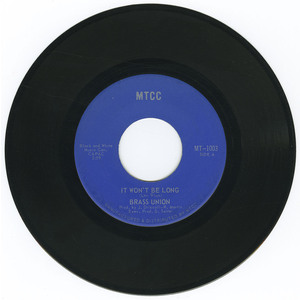
Singles
Gallery
Images
38 images
View All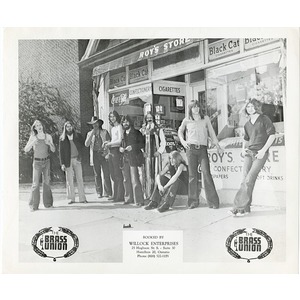
Brass Union
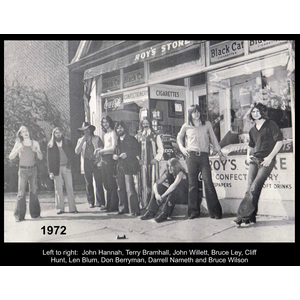
t9FVoTkIQl
QDJxH4Xmkq
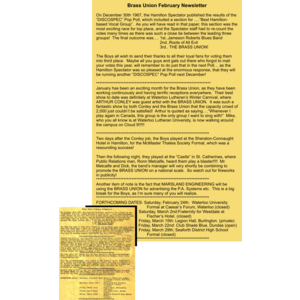
4072@2x
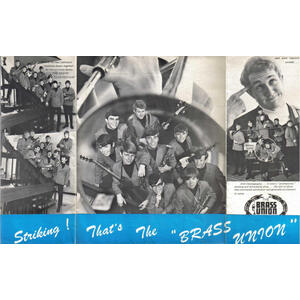
4075@2x
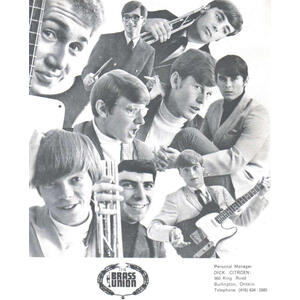
4076@2x
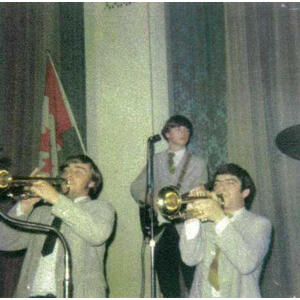
4087@2x
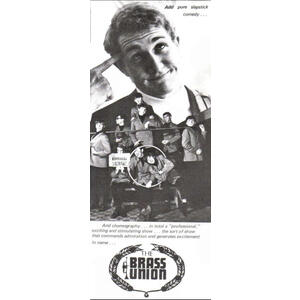
4095@2x
Media
Videos
0 videos
No videos available for this artist.