Artist / Band
Modernes Pickles
Biography
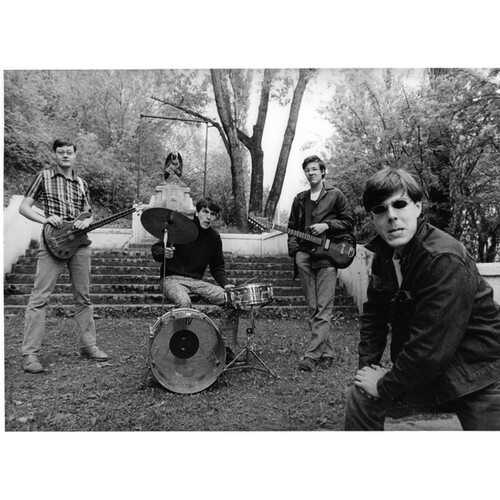
Modernes Pickles were among the earliest truly independent alternative groups to emerge from Quebec City at the dawn of the 1980s. The group brought together two pairs of brothers, Martin and Michel Shink and Bertrand and Robert Szoghy, four young musicians whose interests reached well beyond the confines of punk or new wave. By the end of 1979 they were already experimenting with instruments, tape recorders, film, visual art and homemade songs, developing an approach in which humour, primitive electronics, rock and sheer curiosity could coexist without much concern for genre. Bertrand Szoghy has since singled out hearing The Residents around this period as an especially important revelation; their example suggested that music did not have to obey conventional rules in order to work. The group's surviving archive dates Modernes Pickles from 1979 to 1985.
Much of this early activity took place in the basement at 1320 De Longueuil in Quebec City, the Szoghy family address that would later appear on the band's first record. Using modest equipment and cassette-to-cassette overdubbing, the four accumulated an extraordinary body of homemade recordings rather than waiting for access to a professional studio. Songs and experiments were captured, revised and bounced between tapes, while the members moved freely between instruments and vocals. Michel Fontaine, a friend involved with the group's early filmmaking and creative circle, also appeared on recordings. The band's archive eventually grew to four hour-long cassette compilations as well as a much larger collection of working tapes; surviving early recordings include such titles as ‘Chocolate Lady’, ‘Seagull of Love’ and ‘Headache’. Decades later, the original basement tapes began to be digitized, allowing material that had existed only on aging cassettes to survive.
Modernes Pickles were already reaching listeners before they had a record to sell. A remarkable 1983 Productions Sans Nom press kit states that CKRL-FM in Quebec City began broadcasting their music during the summer of 1980, including ‘Colors’, ‘We Are the Modernes Pickles’ and ‘Destination’. On March 27, 1981, the station devoted a special broadcast to the group and aired twenty-one of their compositions. The same press kit described their songs as deliberately difficult to compare with conventional rock, celebrating the ridiculous while taking aim at the pompous and overblown. The description fits a group whose music could move from short, blunt rock songs to synthesizer experiments, absurdist humour and homemade sound collage without treating any of those approaches as contradictory.
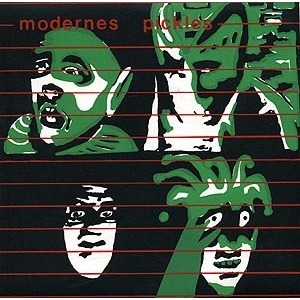
Their first and only single released during the group's original run followed in 1981. Recorded at Studios PSM in Quebec City, the 45 contained ‘We Are the Modern Pickles’, ‘Colors’ and ‘Blue Baby Baby White’, along with a brief unlisted interlude. Martin Shink, Michel Shink, Bertrand Szoghy and Robert Szoghy were all credited with instruments and vocals, with Michel Fontaine supplying backing vocals; the group collectively wrote, produced and directed the record. Jacques Montmigny engineered the session. The original sleeve gives the recording date as August 16, 1981, although the later 1983 press kit remembered it as August 15. Martin Shink recalled in correspondence with the Museum of Canadian Music that approximately 950 copies were printed, while Bertrand Szoghy separately remembered that roughly 850 or fewer were put into circulation, suggesting that not every manufactured copy was distributed. The record was mastered in Montreal.
The single was every bit as homemade visually as the music was independently conceived. Bertrand later recalled that the sleeves were hand silk-screened at Laval University during evenings spent working with artist Serge Brunelle and Martin Shink. Because producing the covers was tedious, they worked in batches and simply changed to different leftover jars of colour as they went. Consequently, several colour combinations exist rather than one fixed sleeve design; Bertrand estimated perhaps four or five variations. Even the group's name left an intriguing artifact from this period. Although the sleeve identifies them as Modernes Pickles, the record label prominently carries the name Pop Pickles. Later accounts describe Pop Pickles as an early name that was abandoned to avoid confusion with PopStress, while other recollections place the Modernes Pickles name back at the group's beginnings. Rather than a neat formal rebranding, the surviving evidence suggests the sort of fluid identity one might expect from a young DIY group inventing itself as it went along.
The transition from basement recording project to live band came relatively late. According to the 1983 press kit, Modernes Pickles played their first concerts on April 23 and 24, 1982 at Café Résistance in Quebec City. By then the members had developed a stage presentation that drew upon their other creative interests. They had made video and Super-8 short films, some of which supplied themes or material for their performances, and the press kit advertised the group not simply as a musical act but as an unpredictable audiovisual show. The live configuration placed Michel Shink on guitar and vocals, Martin Shink on drums and percussion, Bertrand Szoghy on bass, and Robert Szoghy on guitar and vocals.
On June 14, 1982, Modernes Pickles appeared with Black Flag at Club 30/60 in Quebec City, an event remembered both in the group's period press material and later histories. They also performed two concerts at L'État d'Âme that June and, during 1983, appeared repeatedly at Lock-All alongside other members of Quebec City's growing alternative underground. The scene developing around them included groups such as Turbine Depress, Chienne 50¢ and Outbreak, with figures such as Bruno Tanguay helping to create a local network for music existing well outside the city's commercial mainstream. Looking back on the period decades later, Quebec City writer and filmmaker Alain Cliche specifically remembered Modernes Pickles as part of that community and recalled circulating cassette recordings by the band that had never reached vinyl.
That community produced one of Quebec City's most important underground documents in 1983, the Blender Mix compilation. Modernes Pickles contributed ‘Teenage Dropout’ and ‘Big Man’, recorded and mixed at Yves Laberge's eight-track studio in Charlesbourg with the intention of capturing the sound of the live band. Martin Shink sang and played synthesizer on ‘Teenage Dropout’, while Michel Shink handled the vocal and guitar solo on ‘Big Man’; Bertrand Szoghy played bass, Robert Szoghy guitar and Martin drums, with Laberge engineering and mixing the sessions. The compilation was promoted and partly financed through Quebec City shows involving Modernes Pickles, Turbine Depress, Chienne 50¢ and Outbreak under Luc Martineau's Productions Sans Nom. When Maximum Rocknroll encountered Blender Mix, reviewer Tim Yohannan grouped Modernes Pickles and Randypeters among the record's punk bands while characterizing the collection as an unusually eclectic regional document. It is a useful reminder that outsiders could hear punk in Modernes Pickles even when the musicians themselves were never particularly interested in remaining inside that definition.
The group's recorded output was substantially larger than the scant vinyl evidence suggested. In addition to the 45 and four cassette compilations, Modernes Pickles contributed ‘Juvenile Jungle’ to the Quebec compilation That's All Record – 38 Songs From Quebec. Bertrand later remembered recording the piece in a single afternoon, with Martin playing guitar and ARP Odyssey while Bertrand improvised the vocal and lyrics using a paperback copy of Juvenile Jungle. Their cassettes and working tapes preserved dozens of other songs, jams and experiments, much of it unheard outside their immediate circle. That prolific cassette culture helps explain why memories of Modernes Pickles persisted among Quebec City musicians and collectors despite the band leaving behind only one independently released 45 under its own name.
By 1985, Modernes Pickles were preparing what might have transformed their recorded legacy considerably: a proper first LP. Sixteen-track sessions were arranged at PSM Studios and ten songs were laid down as basic tracks, followed by three additional recordings involving The Fleshtones. Robert Szoghy played Fender Telecaster, Bertrand Szoghy played bass and handled production and mixing, and Bruce Edwards engineered the PSM sessions; drums, synthesizers and vocals were intended to be added subsequently. Before the album could be completed, however, the project was abandoned. The surviving two-inch multitrack tapes sat unheard for decades until they were restored and transferred digitally at Studio Piccolo in Montreal in 2024. Material recovered from the sessions includes ‘Can Someone Give Me Joy?’, ‘Cultured Man’, ‘Meilleur’, ‘Rock'n'roll Pas Compliqué’, ‘St-Roch Mall’, a new version of ‘We Are the Modernes Pickles’, ‘People Get Killed and Get Up and Kill’, ‘Eve’ and ‘Zoom’.
Modernes Pickles came to an end around 1985, but its members remained entangled with Quebec's underground music culture. Martin, Michel, Bertrand and Robert appeared in or around a web of subsequent projects that included Les Biberons Bâtis, Les Espadons, Soul Screechers, Unexpected and Camel Clutch, among others. Bertrand and Robert later worked together again in Lunasam and, more recently, Melocordia. More importantly for the historical record, the Szoghy brothers retained an enormous quantity of Modernes Pickles tapes and related documentation. Bertrand spent years digitizing and documenting material from Quebec City, Montreal and Ottawa's independent scenes, while Robert undertook extensive transfers of the group's original cassettes and working tapes. The result is that a band once represented publicly by little more than one obscure 45 and a handful of compilation appearances now has an unusually deep surviving archive.
That archive has begun to alter the band's place in Quebec music history. The Blender Mix recordings were newly remastered from improved sources in 2025, bringing them closer to the sound originally intended in 1983. In 2026, ‘Juvenile Jungle’ resurfaced on Trésor National's Nome Noma 3 – Québec Post-Punk et New Wave 1979–1983, a compilation devoted to Quebec artists working between punk, post-punk, minimal synth, power pop and new wave. The label pressed 1,000 copies and accompanied the LP with an extensive bilingual fanzine; Modernes Pickles were among the artists whose contribution was appearing on vinyl for the first time. Nearly half a century after four Quebec City teenagers began making strange songs on cassette because groups such as The Residents convinced them that they could, the homemade recordings of Modernes Pickles are finally emerging from the basement.
For a group that spent so little time worrying about what category it belonged to, that long delay may be oddly appropriate. Modernes Pickles existed at the point where Quebec City's emerging punk underground met experimental music, primitive electronics, visual art, humour and the possibilities of inexpensive home recording. They made their own tapes, helped make their own sleeves, produced their own record, created films for their performances and accumulated far more music than the record industry of the day ever documented. What once looked from a distance like an obscure Quebec City 45 was actually the visible tip of six remarkably productive years of independent creation.
-Robert Williston
Tracks
41 tracks
-
We are the Modern Pickles
-
Colors
-
Blue Baby Baby White
Plexiglass Sidewalks Forever: Demos, Outtakes & Rarities 1979–1985 (2026)
Showing 10 of 38 tracks
-
Are You a Martian
-
Baby My Band is Back
-
Blue Baby Baby White
-
Bonjour de Bob
-
Brothurs
-
Burning Airwaves
-
Cactus Cowboy
-
Chocolate Lady
-
Colors
-
Deathrace 2000
Discography
Featured Titles
Albums
Singles
Gallery
Images
35 images
View All
Modernes Pickles (2)
Modernes Pickles (3)
Modernes Pickles (4)
Modernes Pickles (5)
_mini1
_mini2
_mini3
_mini4
Media
Videos
0 videos
No videos available for this artist.