Artist / Band
Bleu Néon
Biography
Bleu Néon began as poetry read out loud. In 1982 Alain Tittley spent five nights at Montréal's Cinéma Parallèle performing texts from his collection Le Désert de la parole while his friend Jean Mineau put music underneath them. Tittley later called what those nights started an adventure in music. Three years after that it produced a record.
He came to it with a decade of work already behind him. Born in Ottawa in 1953, Tittley studied French literature at the University of Ottawa from 1969 to 1973 and self-published his first collection of poems, Dans les miroirs de mon sang, in that final year. One copy of it sits in the personal library of Gaston Miron, inscribed to Miron by the author. Through the 1970s Tittley worked in theatre and improvisation, drew and sculpted, made the fifty-copy artist's book Partage in 1975, went to the Rencontre internationale de la contre-culture the same year, and started an experimental film called Ersatz, fifteen minutes of poetry and image with music by Jean Mineau, which he never finished. His circle in Montréal included the poet Gilbert Langevin and the playwright Reynald Bouchard. In 1977 he moved to Saint-Damien-de-Brandon and wrote the book that would eventually send him toward a synthesizer.
The group that formed around the Cinéma Parallèle performances was Tittley on words and voice, Daniel Painchaud on bass, Richard Blais on keyboards and Gilles Brillon. The sleeve of the record credits Brillon with arranging textures, but Tittley's own account of the period puts him on the stage as one of the band, sharing it with Painchaud and Blais. Bleu Néon came out of poetry performance rather than out of a rehearsal room, and the difference is audible on everything they recorded.
By 1984 they had made a film. The Cinémathèque québécoise catalogued a colour video for Néon blafard, four minutes and thirty-seven seconds on three-quarter-inch tape, directed by Gordon Donnelly and distributed by CF Cable TV Inc., the cable operation then serving Montréal and Laval. The date matters. Cité Promise was still a year from being recorded, and the version of Néon Blafard that ended up on the record runs 3:32. The difference in running time raises the possibility that Donnelly's video preserves an earlier or longer form of the song, though the two have never been compared side by side. It also means Bleu Néon had a finished piece of television before it had a commercial release.
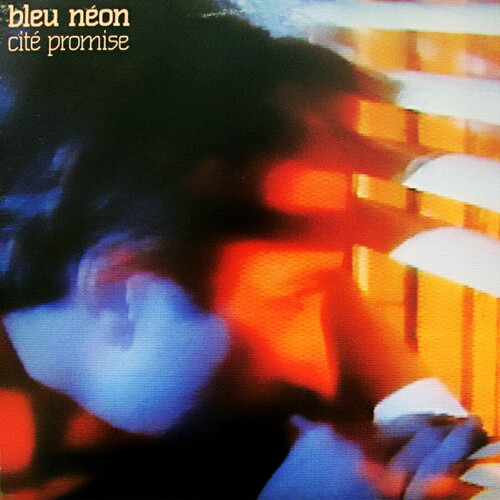
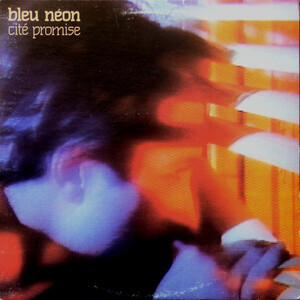
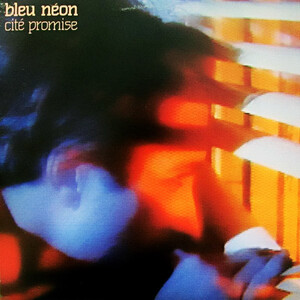
Cité Promise was recorded and mixed in Montréal, Québec in May 1985 and released that September on Les Éditions Du Champ De Mars as CDM-7001, with Distribution Select handling the distribution. The band produced it themselves. Tittley wrote the words and delivered them, Painchaud played bass, Richard C. Blais played synthesizer, Brillon arranged the textures, and the music was credited to Bleu Néon as a group.
There are three pieces on it, and the shape of the record tells you what kind of band this was. Néon Blafard and Exorcisme fill the first side at 3:32 and 4:32. Survivance takes the whole of the second at 8:24. That much room pushed the music past the ordinary limits of new wave and into something closer to staged poetry with electronics, which is why later listeners have heard progressive rock in it alongside the synthesizers and the post-punk chill.
The record described itself as an amalgam of existential poetry and techno-rock, and for once the sleeve copy was accurate. Tittley had been a published poet for twelve years before he was a singer, and Bleu Néon was another container for what he had already been working through in print, on stage and on film. The synthesizers are the surface. Language and atmosphere are what move the thing along.
Cité Promise is the only commercial release the group is known to have made. It went out with the lyrics on an insert, and a promotional twelve-inch was pressed alongside it. Tittley kept working in the same direction for a while afterward, performing with Jean Mineau at the Maison de la culture Marie-Uguay in 1986 as part of Poésie ville ouverte. Mineau carried the approach forward elsewhere too, working with the poet and multimedia artist Princess Demeny as she began turning her own writing into electronic music that year.
The reason there was never a second record comes from Tittley himself. By 1987 he had grown disillusioned with the music business, and as a father he needed something steadier than a career as a singer. He let it go and moved into journalism and communications. He went on to co-found L'Express d'Outremont and edit it, the paper having grown out of an election special produced around the 1991 municipal campaign, and later worked in municipal communications in Outremont. In 2015 he set up a studio at Rivière-Rouge in the Hautes-Laurentides and gave himself to landscape painting. His own account of his life divides it into a multidisciplinary period running from about 1972 to 1987, taking in theatre, poetry, drawing, sculpture, song and film, and then, decades later, the painting. Bleu Néon sits at the very end of the first one.
Richard Blais stayed in music. He has worked since as a Montréal studio and stage keyboardist, author and composer, and still lists Bleu Néon among his former groups alongside Solen, Pangloss, 'Gloss, HOPE, Eternal Mourning, Ten Thousand Souls and Aerial Darkness. He released OM and Avril in 2020 and Suite Laurentienne in 2022, which ties the little 1985 EP to a working life that is still going.
-Robert Williston
Musicians
Alain Tittley: lyrics, vocals
Daniel Painchaud: bass
Richard C. Blais: synthesizer
Gilles Brillon: textures arrangement
Performing group
Alain Tittley
Daniel Painchaud
Gilles Brillon
Richard Blais
Production
Produced by Bleu Néon
Recorded and mixed in Montréal, Québec, May 1985
Music by Bleu Néon
Lyrics by Alain Tittley
Video
Néon blafard, 1984, 4 min. 37 sec., colour, 3/4-inch video
Directed by Gordon Donnelly
Distributed by CF Cable TV Inc.
Catalogued by the Cinémathèque québécoise
Release notes
Released September 1985 on Les Éditions Du Champ De Mars, CDM-7001
Distributed by Distribution Select
Issued with a lyric insert. A promotional 12-inch was also pressed
Survivance occupies the entire second side at 8:24
Discography
Featured Titles
12"
Gallery
Images
1 image
Bleu Néon
Media
Videos
0 videos
No videos available for this artist.