Artist / Band
Steve Tittle
Biography
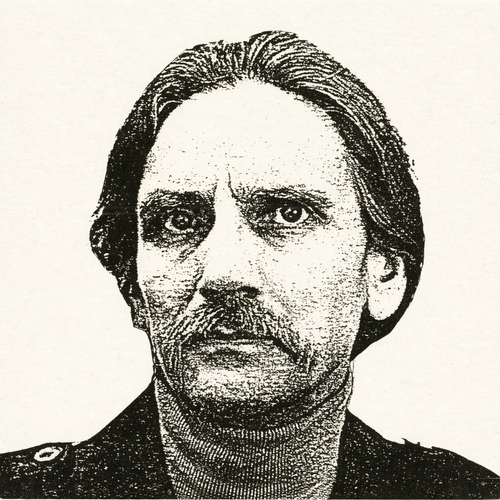
Steve Tittle (John Stephen Tittle) was born in Willard, Ohio on 20 May 1935. He studied composition at Kent State University with Harold Miles, John White and Fred Coulter, and at the University of Wisconsin–Madison with Hilmar Luckhardt, Robert Crane and Burt Levy. He was a school music teacher 1962–65 in Ohio, and his early performance experience was as a trumpet player in the United States Navy bands (including the USS Iowa BB-61 ship's band) and in ensembles in Ohio and Wisconsin.
In 1970 he joined the faculty of Dalhousie University in Halifax, Nova Scotia, where until 1994 he was Associate Professor of Composition and Theory. Founder and co-designer of the Dalhousie Experimental-Electronic Sound Studio, he also inaugurated an improvisation ensemble, Murphy’s Law, which evolved into a formal new-music ensemble. He was a 1971 charter member, secretary and artistic director (1981–86) of NOVA MUSIC (“inNOVAtions in MUSIC”), an ensemble that preceded Murphy’s Law by two years, and in 1989, together with several other Halifax professional musicians, created its successor, Upstream.
In these enterprises, and in numerous solo and ensemble appearances in the city, as conductor, organizer, trumpet and flügelhorn player, and mallet percussionist, he was a catalyst for new music performance life in the Maritimes, in particular introducing the potential of synthesizer and tape composition to the region. He performed with other noted composers and musicians, including Philip Glass and Allen Ginsberg. He was a charter member of the Atlantic Canadian Composers Association and producer of its chamber music recording. He was also a member of SOCAN and the Canadian League of Composers.
After retiring from teaching in 1994, Tittle relocated to Nelson, British Columbia, where he continued composing and living privately in retirement.
Tittle was a prolific composer, primarily in smaller forms. Drawing on influences from jazz, minimalist composers such as Terry Riley, Steve Reich, La Monte Young and Charlemagne Palestine, and non-Western musics, he created in each piece an original statement that is subtle, novel, and engaging both for the performer and the listener. Works such as orange-blossom book, it is all there all the time, where there is no other (only we), let it shine all the time, messages (four), and what finally matters most is grace are poised between Western and Asian aesthetics: an impression of timelessness and mobility tends to disguise tight control of material and logical, dynamic conclusions. The interplay between tape and performer in innocence and natural right, salvation dharma band, and only/other/always achieves a linear unity and contrapuntal contrast that is both lyric and deft.
Notable chamber and electroacoustic works include:
– it is all there all the time (1972) for double bass and harpsichord
– orange-blossom book (1976)
– where there is no other (only we) (1976)
– let it shine all the time (1977)
– innocence and natural right (1980) for vibraphone and tape
– salvation dharma band (1981) for flugelhorn and tape
– (one of the) merely players (1982) for tape and improvising performers
– just like yr daddy done (1983) for tape and male voice
– only/other/always (1987) for oboe and tape
He was commissioned by the Atlantic Symphony Orchestra and Symphony Nova Scotia, Music Gallery New Music Concerts, CBC Radio, the Canadian Electronic Ensemble, the Kronos Quartet, Lawrence Cherney, Rivka Golani, Philippe Djokic, the Atlantic Camera Trio, the Karr-Lewis Duo, Scotia Festival, Technical University of Nova Scotia, and Dalhousie University. He also wrote for CBC Radio drama, the National Film Board of Canada, and the Nova Scotia Communications and Information Centre.
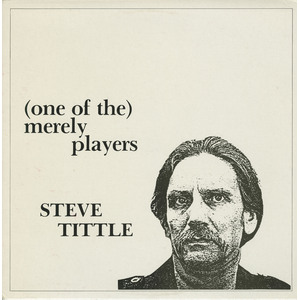
Although prolific as a composer, he recorded only one commercial album: (one of the) merely players, released privately on Nerve Records (Ser. #002), an extremely rare issue documenting his electroacoustic and tape-integrated work.
Steve Tittle died on 25 September 2024 at the age of 89.
-Robert Williston
Tracks
3 tracks
-
(One Of The) Merely Players (Text adapted from Wm. Shakespeare)
-
Just Like Yr Daddy Done (Text partly adapted from traditional blues songs Poem by S. Tittle (ca. 1958); spoken by Miles Tittle)
-
Salvation Dharma Band (For flugelhorn and tape)
Discography
Featured Titles
Albums
Gallery
Images
1 image
Tittle, Steve
Media
Videos
0 videos
No videos available for this artist.