Artist / Band
Shanghai Dog
Biography
Shanghai Dog came together in Vancouver in 1982 from the remains of two of the city’s first-wave punk bands. Guitarist Mike Graham and bassist Ron Allan had been playing in the Subhumans until Brian Goble left to play bass for D.O.A., and drummer Barry Taylor was free after the Young Canadians broke up. Graham, Allan and Taylor had songs and no singer.
Doug Andrew was fronting Soldiers of Sport at City Space, a warehouse on Railway Avenue where artists lived and put on shows a few floors up. There was beer. Spotters on the street watched for police, and by the time the cops got up the stairs the bar was shut tight. Andrew grew up in South Vancouver. As teenagers he and his friends, Jim Imagawa among them (later the Subhumans’ drummer), banged away in their parents’ basements and garages, moving from house to house to give each family a break from the noise. Ben Romanin could already play guitar and showed Andrew a few things. They called the racket Shitrock. Andrew said it was more of a genre than a band. He had been at the first show by the K-Tels, the band that became the Young Canadians, in a little Gastown gallery called Gambatto’s, and had come away thinking Barry Taylor was great. Not long before Soldiers of Sport, he went to Illinois to tend goal in semi-pro hockey. His old basement bandmate Bruce Walther mailed him demo tapes from a new band that needed a singer, and when the team missed the playoffs Andrew came home to take the job.
After one Soldiers of Sport gig, Ron Allan asked Andrew to audition for the new group. Andrew turned him down out of loyalty to his band. Allan said he respected that and reminded him that bands have a habit of breaking up. A few months later guitarist Mark Findler left on a long trip to South America and drummer Mark Hons went to Europe, leaving Soldiers of Sport on hold. Andrew went over to Graham’s place and asked if the job was still open. At the next rehearsal, in Dave Gregg’s house on Gore Street, the band also tried out a second guitarist, Ron Scott, and the five of them clicked straight away.
Within months the Squamish Five were arrested, in January 1983. One of them was Gerry Hannah, the Subhumans bassist whose place Ron Allan had taken, and the day after the arrests Andrew ran into Graham at a mall, where Graham joked that he had never heard of him. Shanghai Dog played many benefits for the group’s legal defence fund. Andrew shared their opposition to Cruise missile parts being built in Canada and to the Red Hot Video chain, but he never supported the bombings. The one at the Litton plant in Toronto went off early and injured several people.
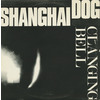
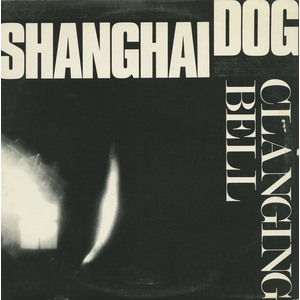
The band recorded its first record at Mushroom Studios with producer David Lloyd and engineers Lindsay Kidd and Keith Stein. Clanging Bell, a four-song 12-inch EP, was issued privately in 1983 with the catalogue number SDEP 001. Maddelena Di Gregorio photographed the five members emerging from deep shadow for the back cover, Bob Mercer designed the sleeve, and Bruce Walther drew the snarling guardian dog on the labels, which mark the sides “This Side” and “That Side.” Graham wrote the title song, Allan and Graham wrote ‘Work Will Set You Free’, Andrew and Graham wrote ‘The Closet’, and ‘Bawl and Change’, one of Andrew’s first songs, was written with Ben Romanin.
CD Presents in San Francisco handled the EP in the States. They came on so late that their logo never got onto the sleeve. Robert Christgau gave it a B+. He heard Mission of Burma’s military beat in it, liked how tight and angry the songs were, and said nobody expected a record like this out of Vancouver, any more than they had expected D.O.A. At Maximum Rocknroll, Jeff Bale picked ‘Bawl and Change’ and ‘The Closet’ as guitar-heavy pop you could dance to. The rest reminded him of the English band Spherical Objects.
The band fell out with CD Presents. On a trip to San Francisco, Ron Allan and label owner David Ferguson got into a screaming match. While they yelled at each other in one room, the others found boxes of Shanghai Dog records in the next room and walked them out the back door. They never got the master tapes. Copies later turned up in a different kind of shrink wrap, and the band figured someone was pressing more
Vancouver promoters liked to put a local band on with whoever was coming through town. Andrew remembered Commodore shows with the Ramones and X, and one with Joan Jett and the Blackhearts that he thought was a bit of an odd fit. They toured the West Coast constantly and went right across the States in a van. Andrew’s list of nights from those years includes Hüsker Dü in Bethesda, Maryland, 7 Seconds in Lexington, Kentucky, and GBH, the Meat Puppets and the Circle Jerks in San Francisco. They played a lot with D.O.A., even down in Texas. Joe Keithley kept a big black book of contacts across North America and shared it with anyone heading out on the road. More than once he got a broke band onto a D.O.A. bill just to get them to the next town. Back then an American friend could drive the gear over the border and nobody worried about work permits. On what was probably their first tour, Andrew sat looking out the windshield at the freeway and felt he was right where he belonged
On July 1, 1983, they played the New York Theatre in Vancouver with D.O.A., Agent 86 and No Exit, and on September 16 they were at the Metropolis in Seattle with D.O.A. and Tse Tse Force. They played the Commodore with D.O.A. and the Actionauts on December 9. On March 11, 1984, they shared a bill with the Meat Puppets and Death’s Ugly Head at Club Minimal in Sacramento. On September 21 they were at Villa Fontana in San Antonio, Texas, with D.O.A. and Die Kreuzen. Back home, they played UBC’s SUB Ballroom with Poisoned, NoMeansNo and Family Plot on February 23, 1985.
The best night of all came at the Jockey Club in Newport, Kentucky, opening for the Replacements. Shanghai Dog liked to open with three or four songs played back to back, and as they tore through them the Replacements began setting cans and bottles from their dressing room along the edge of the high stage, inches from the crowd. The band stopped to collect them as soon as they could. By the time the Replacements went on, everyone was well lit, and they swapped instruments and played covers with the roadies joining in. When Paul Westerberg’s guitar strap came loose during ‘Hitchin’ a Ride’, Andrew ran out to hook it back on, and Westerberg pulled him to the microphone to sing harmony on the chorus. Afterward Andrew spotted Tommy Stinson alone at the end of the bar with a drink and a cigarette. When Andrew pointed from him to the stage, Stinson shrugged as if Andrew had him confused with someone else.
By the second record Shanghai Dog was a four-piece. When Ron Scott stepped back isn’t documented, but he returned as a guest guitarist on the title track, credited on the inner sleeve as Ronny Scott. This Evolution was recorded at Inside Trak Studios in 1985, with David Lloyd producing again and Gary Tole engineering, and was released that year by Undergrowth Records (UG 1304), a division of Collector’s R.P.M. at 456 Seymour Street. Andrew now played guitar as well as singing, and he wrote the words to the first three songs: ‘This Evolution’, ‘American Desert’ and ‘Siren’. Graham wrote the words to most of the rest, Allan wrote ‘Try’, and the music to all but one song was credited to the four of them together. That reflected how the band worked, sharing writing credits and voting on decisions, though Andrew always insisted Graham was the main songwriter and the one he learned the most from. The exception was ‘Hiroshima’, Graham’s slow song from the Subhumans’ 1983 album No Wishes, No Prayers. It was the only Subhumans song Shanghai Dog took on, and Andrew saw it as a sign of the different direction they were after.
The record is darker and more political than the EP. Its lyric sheet, typed in capitals, runs the songs together without breaks. ‘American Desert’ tells of American soldiers moved onto the Nevada test site in 1955 after an atomic blast and the radiation deaths that followed years later. In ‘Siren’ the television cuts to the emergency broadcast and everyone waits for instructions. ‘Security’ is about being watched. ‘Refusal’ is set at a gambling table. ‘On the Rocks’ is a drunk’s night that ends with him asleep on the lawn in the rain. Rodney Graham added organ to the title track and ‘Security’, Alex Phillipides played percussion and helped Ron and Todd Allan build the introduction to ‘Siren’, and Brian Goble, the Subhumans’ singer, credited here as Sunny Boy Roy, sang backing vocals on ‘Hiroshima’. The band also thanked Jeff Walker for his monetary appreciation.
The copy at KCMU, the Seattle college station that became KEXP, has the DJs’ argument about it scribbled on the cover. One hated it and wrote that Andrew sounded like “Geddy Lee with a lisp.” Another wrote back that it was a new music rock band, and a pretty good one
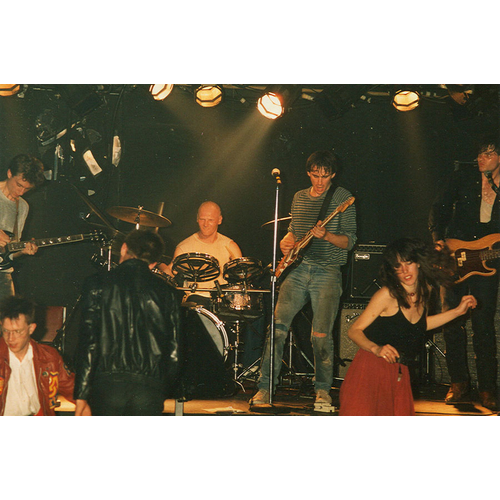
Lane Hartwell also photographed the band at the Bridge in Toronto on April 25, 1986, with Graham, Taylor, Andrew and Allan lined up across the stage. Shanghai Dog broke up around that time. Andrew later said the Vancouver scene had been getting less fun, and a band run by consensus was hard to keep together. ‘American Desert’ reached a wider audience in 1991 on Zulu Records’ double CD Last Call: Vancouver Independent Music 1977–1988. Its booklet said all that touring had made Shanghai Dog as popular away from Vancouver as at home.
Andrew and Graham kept working together in Tin God from about 1987 to 1990. The band went through drummers including Scott Beadle of the Hip Type and Ken Morrison of the Swagmen, with Bruce Walther and later Jaime Nicholson of NG3 on bass. Tin God sold cassettes at shows and in independent record stores but never put out vinyl. Its last session in 1990 produced Graham’s ‘Miles to Sunrise’, with Sons of Freedom singer Jim Newton producing and that band’s Don Short on drums. Graham stopped playing in bands that summer and stayed away until he rejoined the Subhumans in 2005. Barry Taylor played with Roots Roundup. Ron Allan joined the Scramblers and later moved to Austin, Texas, where he took up the upright bass.
Andrew spent the early 1990s working in plumbing supply warehouses. In the mid-1990s a friend asked him to play a St. Patrick’s Day party, and the acoustic group he pulled together with mandolin, banjo, accordion and upright bass became the Circus in Flames. About twenty years after Shanghai Dog ended, Ron Allan called him out of the blue, flew up to record the Circus in Flames album A Little Bit of Gasoline, and toured with the band. Allan also brought in pedal steel guitarist Buddy Cage for the band’s version of ‘Someday Soon’ on the 2007 Stony Plain album The Gift: A Tribute to Ian Tyson.
Andrew still pulls out ‘American Desert’ now and then, and he played it in 2017 at a tribute to Brian Goble and Howard Rix. That year he admitted he hadn’t listened to the old records in a while. “As far as the band goes, I’m very proud of it.”
-Robert Williston
Tracks
14 tracks
Clanging Bell (EP) (1984)
4 tracks
-
Bawl and Change
-
Work Will Set You Free
-
Clanging Bell
-
The Closet

This Evolution (1985)
10 tracks
-
This Evolution
-
American Desert
-
Siren
-
Hiroshima
-
Refusal
-
Security
-
In the Distance
-
Past Tense
-
Try
-
On the Rocks
Discography
Featured Titles

Albums
12"
Compilation Tracks

Gallery
Images
1 image
Shanghai Dog
Media
Videos
0 videos
No videos available for this artist.